Glossopteris
Glossopteris is a genus of fossilized woody plants that thrived during the Permian and Triassic periods, roughly 300 to 200 million years ago. These plants…
What is Glossopteris?
Glossopteris is a genus of fossilized woody plants that thrived during the Permian and Triassic periods, roughly 300 to 200 million years ago. These plants were a dominant feature of the flora on Gondwana, an ancient southern supercontinent.1
The most common fossil of Glossopteris is a tongue-shaped leaf characterized by a prominent midrib and reticulate venation. As a seed fern, it reproduced via seeds, with various reproductive structures attached directly to its leaves.12
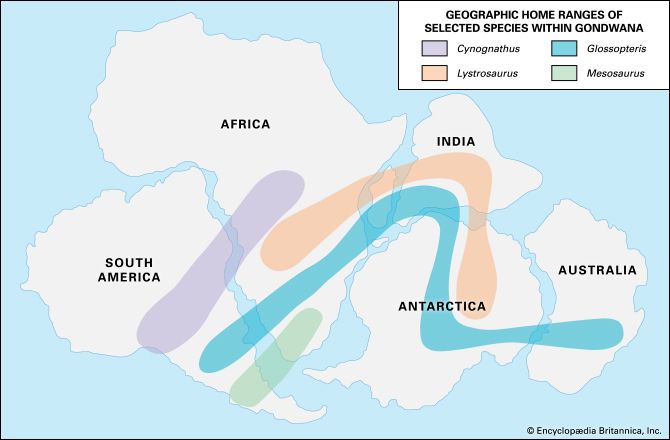
The widespread distribution of Glossopteris fossils across disparate southern landmasses—including South America, Africa, India, Australia, and Antarctica—served as critical early evidence for continental drift1. By demonstrating that these now-separated continents were once joined, the plant’s fossil record helped support the eventual development of plate tectonics theory.2
What other types of fossils provide evidence for continental drift?
Beyond the plant fossil Glossopteris, several animal fossils provided critical paleontological evidence for continental drift by demonstrating that landmasses now separated by vast oceans were once connected as part of the supercontinent Gondwana.32
Key fossil evidence includes:
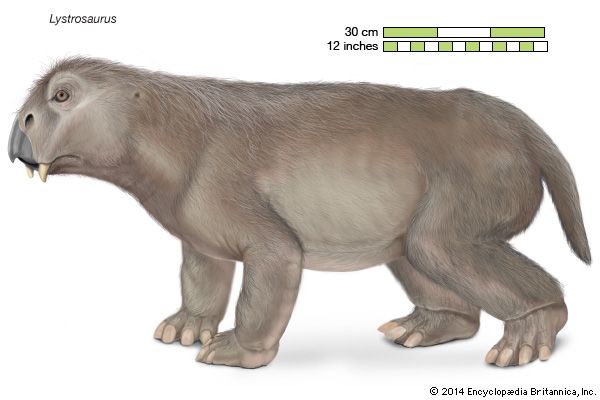
- Lystrosaurus: This medium-sized, herbivorous synapsid lived during the late Permian and early Triassic periods. Its fossils have been discovered in Africa, India, and Antarctica. Because this animal was not capable of crossing broad oceans, its presence on these distant continents supports the theory that they were once joined.3
- Mesosaurus: An early aquatic reptile from the early Permian, Mesosaurus lived in freshwater lakes and ponds. Its fossils are found in both South Africa and South America. Since it is unlikely that this freshwater animal could have traversed the saline waters of the Atlantic Ocean, its distribution is considered some of the earliest proof of continental drift.4
- Cynognathus: A genus of cynodont (a group of mammal-like reptiles) from the Triassic Period, its fossils have been found in both South America and Africa. The geographic pattern of these discoveries is frequently cited as evidence that these continents were formerly connected.5
How did Alfred Wegener first propose the theory of Pangea?
German meteorologist Alfred Wegener first proposed the existence of the supercontinent Pangea in 1912 as a central component of his theory of continental drift.1011
Wegener’s hypothesis was sparked by his observation of the striking similarity between the coastlines of eastern South America and western Africa. While earlier scientists had suggested these lands were once connected, they typically argued that the intervening oceans formed because parts of the supercontinent had subsided or sunk. Wegener challenged this view, proposing instead that the continents had slowly moved thousands of miles apart over vast periods of geologic time.101211
To support his theory, Wegener compiled geological and paleontological evidence, such as:
- Matching rock strata and mountain ranges across separated continents.1013
- The presence of identical fossil organisms on continents now divided by oceans, which could not have crossed such distances.1012
- Similar climate belts and geomorphology between regions.12
Wegener published his comprehensive findings in his 1915 book, The Origin of Continents and Oceans. Although his theory was initially rejected due to a lack of a plausible driving mechanism, it was later vindicated and incorporated into the modern theory of plate tectonics.101211
What are the main differences between the supercontinents Gondwana and Pangea?
The primary difference between Pangea and Gondwana lies in their scale and composition. Pangea was a massive supercontinent that incorporated almost all of Earth’s landmasses, covering roughly one-third of the planet’s surface. In contrast, Gondwana was a smaller supercontinent that constituted only the southern portion of Pangea.14215
Key distinctions include:
- Composition: Pangea was formed by the collision of Gondwana (the southern landmass) with Laurasia (the northern landmass, comprising North America, Europe, and Asia). Gondwana itself consisted of present-day South America, Africa, Arabia, Madagascar, India, Australia, and Antarctica.152
- Timeline: Gondwana was fully assembled by the late Precambrian (about 600 million years ago), long before the formation of Pangea, which was fully assembled between 300 and 200 million years ago.152
- Breakup: The breakup of Pangea began as the supercontinent fragmented into its constituent parts, including the separation of Gondwana from Laurasia. Gondwana subsequently underwent its own multi-stage breakup, beginning in the Jurassic Period about 180 million years ago.15
Sources
- Glossopteris — Encyclopædia Britannica
- Gondwana — Encyclopædia Britannica
- Lystrosaurus — Encyclopædia Britannica
- continental drift — Encyclopædia Britannica
- Antarctica - Antarctica and continental drift — Encyclopædia Britannica
- Earth sciences - The theory of plate tectonics — Encyclopædia Britannica
- plate tectonics - Gestation and birth of plate-tectonic theory — Encyclopædia Britannica
- Mesosaurus — Encyclopædia Britannica
- cynodont — Encyclopædia Britannica
- Alfred Wegener — Encyclopædia Britannica
- plate tectonics - Evidence supporting the hypothesis — Encyclopædia Britannica
- Spotting a Supercontinent: How Pangea Was Discovered — Encyclopædia Britannica
- Pangea — Encyclopædia Britannica
- continent: Top Questions — Encyclopædia Britannica
- supercontinent — Encyclopædia Britannica
Published on · 3 min read