Seed Fern
Seed ferns, or pteridosperms, are not a single taxonomic family but rather a loose, diverse confederation of extinct gymnospermous seed plants that…
What were the major groups or families of seed ferns?
Seed ferns, or pteridosperms, are not a single taxonomic family but rather a loose, diverse confederation of extinct gymnospermous seed plants that flourished from the Devonian through the Permian periods. Because they are a broad, informal grouping, they are often subdivided into various orders and lineages.1234
Key groups and related classifications include:
- Pteridospermophyta: This division encompasses the primary seed ferns. While many are Paleozoic, some orders persisted into the Cretaceous Period.4
- Caytoniales and Glossopteridales: These are two specific orders within the seed ferns that survived into the Cretaceous. The Glossopteridales are sometimes ranked separately and are considered by some to be closely related to the ancestors of primitive angiosperms.4
- Cycadophytes: Many botanists place seed ferns within a broader evolutionary lineage that includes cycads and cycadeoids, noting structural similarities in their stems and reproductive strategies.43
What are some of the most well-known seed fern fossil species?
Seed ferns, or pteridosperms, represent a diverse group of extinct gymnosperms that possessed fernlike foliage but reproduced via seeds. Several genera are particularly well-known in the fossil record:
- Glossopteris: A prominent genus from the Permian and Triassic periods, these woody plants were a major component of the flora on the southern supercontinent of Gondwana. They are most commonly identified by their tongue-shaped leaves with a distinct midrib.81
- Medullosa: These plants grew as upright, unbranched woody trunks topped with a crown of large, fernlike fronds. They are notable for producing large seeds, such as Pachytesta gigantea, which could reach up to 7 cm (2.7 inches) in length.4
- Callistophyton: Unlike the tree-like Medullosa, this genus consisted of woody vines.4
- Neuropteris and Pecopteris: These taxa were common in Carboniferous floras, where they typically grew as low shrubs in coal swamps.1
- Caytonia: A genus of Mesozoic gymnosperms whose seeds were enclosed in a carpellike structure, leading some researchers to speculate about their evolutionary relationship to angiosperms.5
When did seed ferns first appear in the fossil record, and when did they go extinct?
Seed ferns, also known as pteridosperms, first appeared in the fossil record during the Devonian Period, which began approximately 419.2 million years ago.52
These plants were a dominant form of vegetation throughout the late Paleozoic Era and remained a significant component of global flora into the Mesozoic Era. While the term “seed fern” refers to a diverse and loose assemblage of extinct gymnospermous plants rather than a single lineage, various groups within this classification persisted well into the Cretaceous Period, which ended 66 million years ago5.7
How do paleobotanists study and identify seed fern fossils?
Paleobotanists study and identify seed fern fossils by analyzing both their macroscopic physical structures and their microscopic reproductive components. Because seed ferns were a diverse group, researchers rely on several key methods to classify these extinct plants:
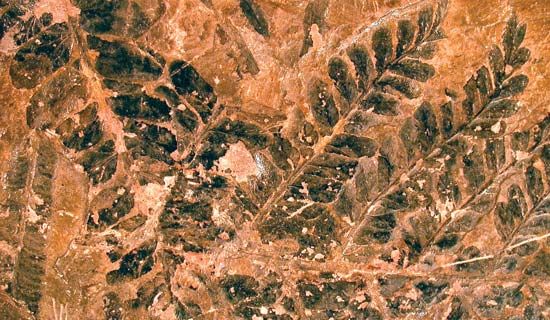
- Morphological Analysis: Paleobotanists examine the physical form of fossilized remains, such as large compound leaves and stems. While these plants were historically confused with true ferns due to their foliage, researchers distinguish them by identifying reproductive organs—specifically ovules and pollen-bearing structures—attached directly to the fronds.17
- Anatomical Comparison: The internal structure of seed fern stems is a critical diagnostic tool. Unlike conifers, which possess compact wood, seed fern stems typically feature soft, loose wood with relatively large zones of cortex and pith, a characteristic that helps distinguish them from other gymnosperms.7
- Palynology: This discipline involves the study of fossilized pollen and spores. Because these microfossils are highly resistant to decay, they are often extracted from sedimentary rocks and coal deposits. Analyzing their morphology allows scientists to delineate the geographical distribution and evolutionary relationships of plant groups, even in sediments where large fossils are absent.5
- Reproductive Studies: Researchers investigate the development of seeds and pollen organs. The presence of complex structures, such as the large seeds of Medullosa or the integumented ovules found in various species, provides essential data for understanding the evolutionary history and reproductive strategies of these plants.1712
Sources
- seed fern — Encyclopædia Britannica
- gymnosperm - Earliest gymnosperms — Encyclopædia Britannica
- cycadophyte - Annotated classification — Encyclopædia Britannica
- seed fern — Merriam-Webster
- Fern - Fossil record — Encyclopædia Britannica
- Pteropsid — Encyclopædia Britannica
- cycadophyte - Seed ferns — Encyclopædia Britannica
- Glossopteris — Encyclopædia Britannica
- Caytonia — Merriam-Webster
- Pteridospermaphyta — Merriam-Webster
- Carboniferous Period - Plants — Encyclopædia Britannica
- palynology — Encyclopædia Britannica
- geology - Paleobotany — Encyclopædia Britannica
- gymnosperm - Evolution and paleobotany — Encyclopædia Britannica
Published on · 3 min read