Lizardfish
A lizardfish is any of approximately 57 species of marine fish belonging to the family Synodontidae. These fish are primarily found in tropical regions and…
What is lizardfish?
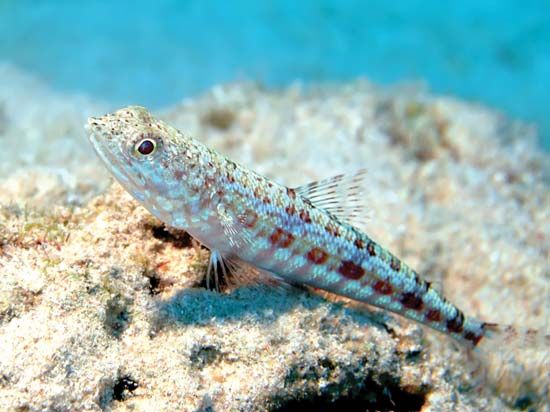
A lizardfish is any of approximately 57 species of marine fish belonging to the family Synodontidae. These fish are primarily found in tropical regions and are characterized by their elongated, rounded bodies and scaly heads that resemble those of a lizard.12
Typically growing to a maximum length of about 50 centimeters (20 inches), lizardfish are often mottled or blotched in color, which allows them to camouflage effectively with their surroundings. They generally inhabit shallow waters, frequently residing in sandy or muddy areas where they may partially bury themselves in the bottom.1
As carnivores, they possess many sharp teeth used to capture and hold their prey. While they are occasionally caught by fishermen, they are not typically considered a desirable food source.1
How do lizardfish use camouflage to hunt?
Lizardfish utilize a combination of physical appearance and behavior to hunt effectively through background matching. Their bodies are characteristically mottled or blotched, which allows them to blend seamlessly with the sandy or muddy bottoms of their shallow-water habitats.1
To enhance this camouflage, lizardfish often lie partially buried in the substrate, minimizing their profile and making them nearly invisible to unsuspecting prey. By remaining stationary and matching the texture and color of the seafloor, they can wait for smaller fish to swim within range. Once a target is close enough, they use their many sharp teeth to capture and hold the prey.1
What other marine animals live in sandy or muddy ocean floors?
Many marine animals inhabit sandy or muddy ocean floors, collectively known as the benthos. These organisms are often categorized as infauna—those that live within the sediments—or epifauna, which live upon the seafloor surface.56
Common Inhabitants of Soft Bottoms
- Mollusks: Many bivalves burrow into sediments to feed or remain sheltered from predators, often extending siphons to the surface to breathe and feed. Scaphopods (tusk shells) dwell directly in sand or sandy mud, using head tentacles to capture prey like protozoa and small crustaceans.78
- Worms: Polychaete worms are among the most important deposit feeders in soft-bottom environments, playing a key role in the ecosystem.5
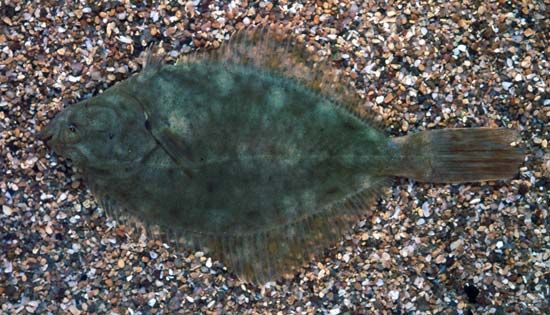
- Flatfishes: Species such as flounders are well-adapted to these habitats. They often lie partially buried in the sand or mud with only their eyes protruding, waiting to ambush prey.9
- Echinoderms: Various echinoderms, including brittle stars and sea stars, are common in these areas, acting as scavengers or predators.1058
- Crustaceans: Many types of crustaceans, such as amphipods, inhabit these sediments, particularly in areas like seagrass beds.8
These environments are often rich in biological activity, especially in protected bays and inlets where burrowing animals create oxygen and nutrient fluxes through their movement and irrigation of burrow systems.811
What are some other examples of predatory fish with sharp teeth?
Many predatory fish have evolved specialized, sharp teeth to capture and hold their prey. These adaptations vary significantly depending on the species’ hunting strategy and diet.
Examples of Predatory Fish with Sharp Teeth
- Barracudas: These voracious predators are well-known for their long, piercing canine teeth, which are specifically adapted for stabbing and holding onto fast-moving prey.1516
- Piranhas: Despite their modest size, piranhas possess short, powerful jaws equipped with razor-sharp teeth. They are famous for their ability to quickly strip flesh from their victims, often hunting in large schools.17
- Tigerfish: Considered one of the largest predatory ostariophysans, the tigerfish (Hydrocynus vittatus) is defined by its massive, sharp teeth and high-speed swimming ability, making it a formidable predator.17
- Chiasmodontidae (Swallowers): These deep-sea fish feature large, backward-pointing teeth that help them secure and hold prey, often allowing them to consume fish larger than themselves.18
- Wrasses: Many species in this family are characterized by prominent, outcurving canine teeth at the ends of their jaws, which assist in their feeding habits.18
- Sharks: Many dangerous shark species, such as the great white shark, tiger shark, and hammerhead, possess large, cutting teeth designed for tearing flesh.19
Sources
- lizardfish — Encyclopædia Britannica
- lizard fish — Merriam-Webster
- coloration - Background matching — Encyclopædia Britannica
- scorpaeniform - Camouflage and coloration — Encyclopædia Britannica
- fish - Locomotion — Encyclopædia Britannica
- mollusk - Habitats, feeding habits, and associations — Encyclopædia Britannica
- What Is a Whale Graveyard? — Encyclopædia Britannica
- benthos — Encyclopædia Britannica
- Marine ecosystem - Benthos — Encyclopædia Britannica
- cnidarian - Distribution and abundance — Encyclopædia Britannica
- pleuronectiform - Feeding behaviour — Encyclopædia Britannica
- pleuronectiform - Reproduction — Encyclopædia Britannica
- infauna — Merriam-Webster
- littoral zone — Encyclopædia Britannica
- perciform - Form and function — Encyclopædia Britannica
- ostariophysan - Feeding habits — Encyclopædia Britannica
- perciform - Annotated classification — Encyclopædia Britannica
- perciform - Feeding behaviour — Encyclopædia Britannica
- perciform - Danger to human life — Encyclopædia Britannica
- chondrichthyan - Danger to human life — Encyclopædia Britannica
Published on · 3 min read