North Siberian Lowland
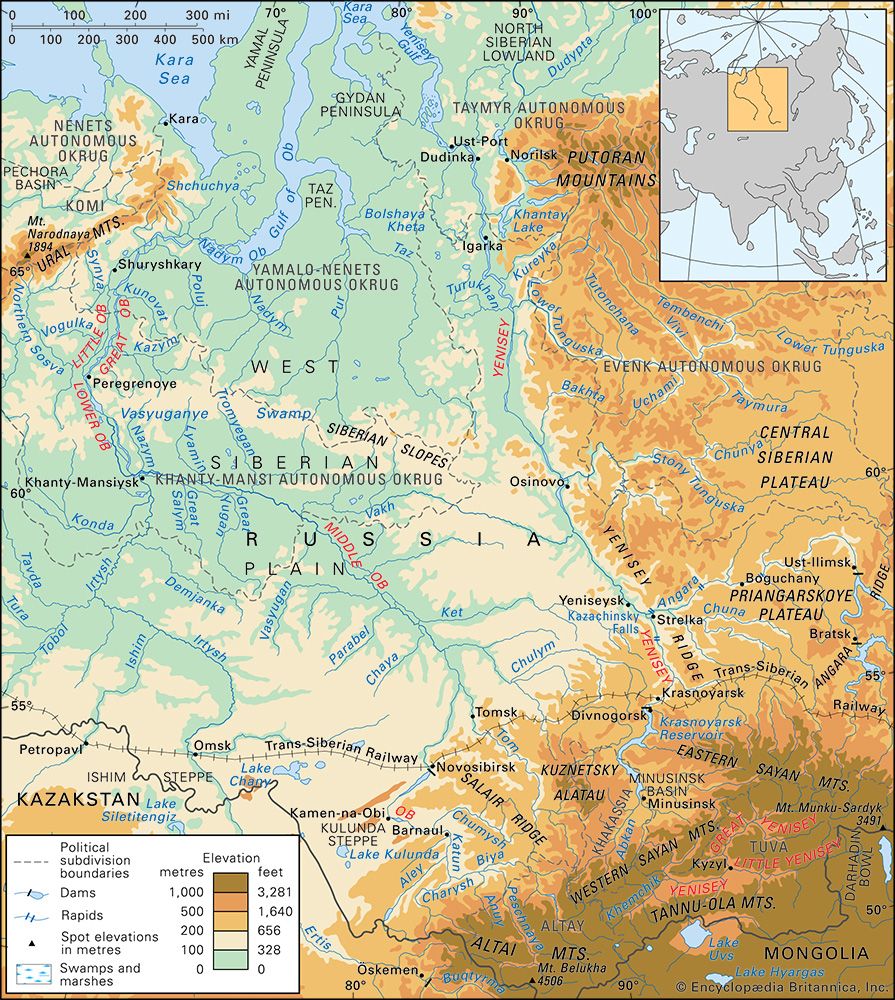
The North Siberian Lowland is a vast, low-lying region located in east-central Russia. Stretching 1,850 miles (3,000 km) from the Yenisey River in the west…
What is North Siberian Lowland?
The North Siberian Lowland is a vast, low-lying region located in east-central Russia. Stretching 1,850 miles (3,000 km) from the Yenisey River in the west to the Kolyma River in the east, the region reaches widths of up to 375 miles (600 km) and sits at an elevation of 165–230 feet (50–70 m) above sea level.1
Geographically, the lowland is bordered by the Central Siberian Plateau to the south and the Byrranga Mountains of the Taymyr Peninsula to the north, with the Laptev Sea lying to the east. The terrain is characterized by frequent low ridges, hills, and extremely swampy ground. Due to the harsh climate and permafrost, the area is dominated by tundra or forest-tundra vegetation. Subsections of the plain are often referred to by local names, such as the Taymyr Plain in the west and the Yana-Indigirka and Kolyma plains east of the Lena River.12
What is permafrost and how does it affect the landscape?
Permafrost is defined as ground—including rock or soil—that remains at or below 0 °C (32 °F) for at least two consecutive years. While some permafrost is “dry,” most is consolidated by ice. In these regions, the surface layer that thaws during the summer and freezes in the winter is known as the active layer.3
Impact on the Landscape
Permafrost significantly shapes the physical environment, particularly in fine-grained sediments where ground ice can accumulate in large lenses. Its influence includes:4
- Thermokarst Formation: When ground ice melts due to climate warming or human activity, the ground settles unevenly, creating a landscape of pits, mounds, sinkholes, and hummocks known as thermokarst.5
- Hydrological Changes: Thawing can lead to the formation of lakes and ponds in surface depressions. Furthermore, it can trigger the release of trapped pollutants and heavy metals into river systems, often turning water orange and harming aquatic life.46
- Greenhouse Gas Feedback: Thawing permafrost releases methane, a potent greenhouse gas, which contributes to further atmospheric warming and accelerated thawing.6
- Engineering Challenges: Permafrost provides a stable foundation only while frozen. Thawing causes the ground to lose strength and change volume, leading to the subsidence of roads, buildings, and infrastructure.478
What kind of animals are adapted to live in the tundra?
Animals in the tundra have evolved specialized adaptations to survive extreme cold, limited food, and harsh seasonal shifts.
Mammals
Large herbivores like reindeer (caribou) and musk oxen utilize their large body size to conserve heat. Musk oxen possess thick coats for insulation, while reindeer use sharp hooves to forage for plants beneath the snow. Small mammals, most notably lemmings, remain active all winter, living and reproducing in the subnivean zone (under the snow). Predators such as Arctic foxes and wolves often follow the seasonal movements of their prey, while polar bears hunt seals along the coast.1011
Birds
Most tundra birds are migratory, arriving in summer to nest when insects and food are abundant. Year-round residents are rare; the ptarmigan and snowy owl are notable exceptions snowy owl are notable exceptions. Ptarmigans have heavily feathered feet for insulation, while snowy owls may migrate to forests if food becomes scarce.1211
Key Adaptations
- Camouflage: Many species, including Arctic hares, foxes, and ptarmigans, undergo seasonal color shifts, sporting white coats in winter to blend into the snow.10
- Migration: Because hibernation is difficult due to the short summer, many species migrate to warmer regions in autumn.11
How does the taiga forest differ from the tundra biome?
The taiga (or boreal forest) and the tundra are distinct biomes that form a transition from forested regions to the treeless Arctic. While they share cold northern latitudes, they differ significantly in vegetation, climate, and soil characteristics.
Key Differences
- Vegetation: The taiga is defined by its vast, circumpolar belt of coniferous trees, such as pine, spruce, larch, and fir, which are adapted to long, cold winters. In contrast, the tundra is a treeless landscape characterized by low-lying, cold-tolerant vegetation, including lichens, mosses, sedges, and dwarf shrubs like willow and birch.1516
- Climate and Growing Season: The taiga experiences a moderate to high amount of annual precipitation and a growing season long enough to support dense forest growth. The tundra faces more extreme conditions, with a very short summer and persistent permafrost that prevents deep root growth and contributes to poor drainage.1516
- Transition Zone: The two biomes are separated by a “forest-tundra” ecotone, where the forest becomes sparse and eventually gives way to the open tundra.216
Sources
- North Siberian Lowland — Encyclopædia Britannica
- Asia - North and Central Asia — Encyclopædia Britannica
- permafrost — Encyclopædia Britannica
- thermokarst — Encyclopædia Britannica
- permafrost - Climatic change — Encyclopædia Britannica
- Arctic - Terrain of the Arctic — Encyclopædia Britannica
- permafrost - Air temperature and ground temperature — Encyclopædia Britannica
- permafrost - General issues — Encyclopædia Britannica
- permafrost - Highways and railroads — Encyclopædia Britannica
- Tundra - Arctic mammals — Encyclopædia Britannica
- Tundra - Effects of human activities and climate change — Encyclopædia Britannica
- Canada - Tundra — Encyclopædia Britannica
- Tundra - Birds — Encyclopædia Britannica
- Asia - The tundra — Encyclopædia Britannica
- Taiga — Encyclopædia Britannica
- Taiga - Distribution — Encyclopædia Britannica
- Russia - Taiga — Encyclopædia Britannica
Published on · 3 min read