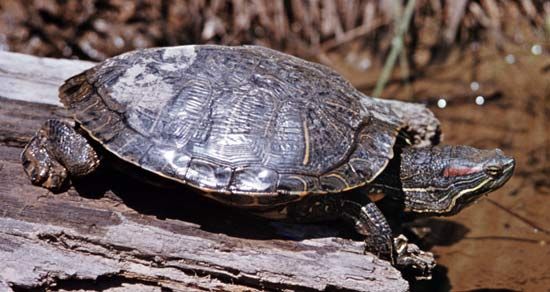
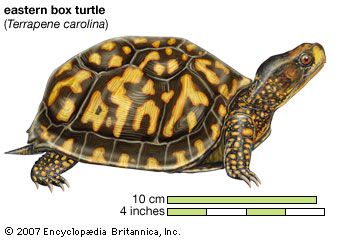
Spotted Turtle
The spotted turtle (Clemmys guttata) is a small, semi-aquatic reptile belonging to the family Emydidae. Found across regions ranging from southern Canada to…
What is spotted turtle?
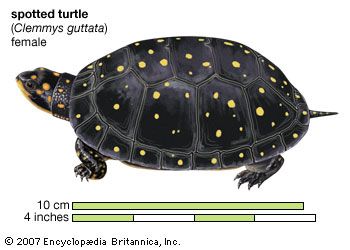
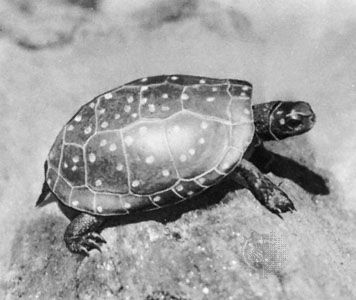
The spotted turtle (Clemmys guttata) is a small, semi-aquatic reptile belonging to the family Emydidae. Found across regions ranging from southern Canada to the central and eastern United States, this species is characterized by its smooth, brown upper shell, which is adorned with distinctive round, bright-yellow or orange spots. Its lower shell is typically blackish with similar yellow or orange markings.123
Reaching a shell length of approximately 10 centimeters (4 inches), the spotted turtle is a slow-moving animal that inhabits shallow freshwater environments such as bogs, ponds, and ditches. While they are not social animals, they are frequently observed basking in groups in the sun. The species is part of the genus Clemmys, which includes four North American turtle species.142
Why is the spotted turtle considered an endangered species?
What are the primary predators of freshwater turtles?
Freshwater turtles face different threats depending on their life stage. While adult turtles are generally well-protected by their shells, they are still vulnerable to specific predators and environmental pressures.
Predation by Life Stage
- Eggs and Hatchlings: This is the most vulnerable period for freshwater turtles. Nests and young turtles are frequently preyed upon by a variety of animals, including birds, raccoons, and various fish.3
- Adults: Once they reach maturity, many freshwater turtles have few natural enemies. However, crocodilians and alligators possess the strength to crush the shells of most freshwater species. Additionally, mammalian predators are capable of killing adult turtles when they are on land.5
Human Impact
Beyond natural predation, human beings represent a significant threat to adult turtles. Humans impact these populations through the destruction of habitats, the harvesting of turtles for meat, and the capture of individuals for the exotic pet trade. Furthermore, turtles are frequently injured or killed as bycatch in commercial fishing operations.3
How do turtles adapt to living in different water environments?
Turtles have evolved a variety of physical and physiological adaptations to thrive in diverse water environments, ranging from small ponds and rivers to coastal estuaries and open seas.
Structural Adaptations for Movement
The turtle’s shell is a primary adaptation for its environment. Aquatic species typically possess streamlined shells to reduce drag and improve swimming efficiency, a trait most highly developed in sea turtles. In contrast, bottom-dwelling species, such as snapping turtles and the matamata, often have less streamlined, ridged carapaces that assist in camouflage against the river or lake floor.63
Feeding Mechanisms
Aquatic turtles have developed specialized feeding strategies to capture prey in water. Many pleurodiran (side-necked) turtles, such as the matamata, utilize a gape-and-suck mechanism. By rapidly enlarging their mouth and throat cavity, they create a vacuum that pulls in both water and prey. Additionally, aquatic turtles have eyes that can quickly adjust to provide clear vision in both aerial and aquatic environments.6
Respiration and Osmoregulation
Because turtles possess a rigid shell, they cannot use the expansion of the body wall for breathing in the same way as other reptiles. Instead, they rely on specialized muscles to inflate their lungs. In aquatic species, the pressure of the surrounding water on the limbs can assist in the expiration process.9
For species living in brackish or saltwater environments, such as the terrapin or certain river turtles, the ability to tolerate varying levels of salinity is crucial. Some species can tolerate salinities up to half that of seawater, allowing them to inhabit tidal rivers and estuaries.10
Sources
- spotted turtle — Encyclopædia Britannica
- spotted turtle — Merriam-Webster
- turtle - Feeding behaviour — Encyclopædia Britannica
- Clemmys — Encyclopædia Britannica
- leatherback sea turtle — Encyclopædia Britannica
- turtle - Form and function — Encyclopædia Britannica
- alligator snapping turtle — Encyclopædia Britannica
- What do turtles eat? — Encyclopædia Britannica
- turtle - Habitats — Encyclopædia Britannica
- What are turtle shells made of? — Encyclopædia Britannica
- Respiratory system - Reptiles — Encyclopædia Britannica
- Biosphere - Salinity — Encyclopædia Britannica
- heteropteran - Respiratory system — Encyclopædia Britannica
Published on · 3 min read