Wheel Bug
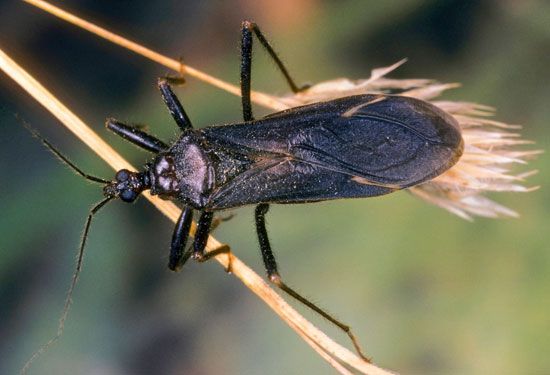
A wheel bug (Arilus cristatus) is a large assassin bug native primarily to North America, ranging from the southern and eastern United States into Mexico and…
What is wheel bug?
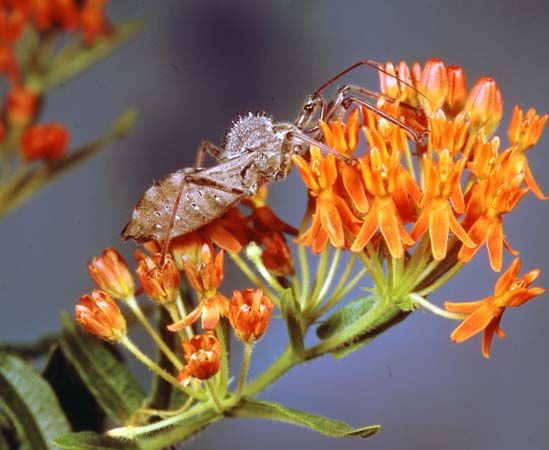
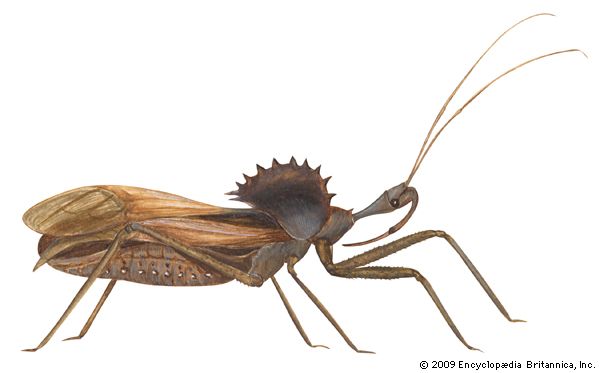
A wheel bug (Arilus cristatus) is a large assassin bug native primarily to North America, ranging from the southern and eastern United States into Mexico and Central America. It is easily identified by the distinctive, semicircular, notched crest on the top of its thorax, which resembles a cogwheel.12
As a top predator, the wheel bug is considered beneficial to ecosystems and gardens because it feeds on various insects, including caterpillars, sawfly larvae, and the invasive brown marmorated stink bug. It uses raptorial front legs to grasp prey and a specialized beak to inject venomous saliva, which liquefies the victim’s internal tissues for consumption.12
While wheel bugs are not aggressive toward humans, they can deliver a painful bite if handled. They are commonly found in meadows, woodlands, and residential areas, often near outdoor lights.12
What are other types of assassin bugs?
The assassin bug family (Reduviidae) contains approximately 7,000 species, exhibiting a wide range of predatory behaviors and physical adaptations. Beyond the well-known wheel bug, other notable types include:
- Kissing bugs (Subfamily Triatominae): These are medically significant hematophagous parasites that feed on the blood of vertebrates. Certain species, such as Rhodnius prolixus, are primary vectors for the parasite that causes Chagas disease.4
- Ambush bugs (Subfamily Phymatinae): These small predators hide on flowers or vegetation, using their enlarged, pincer-like forelegs to capture prey—sometimes as large as bumblebees or butterflies—that wander too close.45
- Masked hunters (Reduvius personatus): Known for their ability to camouflage, the immature stages of this species cover themselves in dust and lint using sticky hairs. They are often found in homes preying on bedbugs and flies.4
- Bee assassins (Genus Apiomerus): These bugs frequent flowering plants and coat their legs in sticky resins to help capture bees.4
- Thread-legged bugs: These insects, such as Emesaya brevipennis and the Australian Stenolemus bituberus, possess long, slender legs. S. bituberus is notable for using aggressive mimicry to lure spiders into striking distance.4
- Feather-legged bugs (Subfamily Holoptilinae): These bugs use a specialized abdominal secretion to attract and paralyze ants before consuming them.4
- Black corsair (Melanolestes picipes): A dark-colored predator typically found under bark or stones that is capable of delivering a painful bite.4
How do insects use venom to digest their prey?
Many predatory insects, particularly those in the suborder Heteroptera, utilize specialized mouthparts to perform extra-oral digestion. This process allows them to consume prey that may be significantly larger than themselves by liquefying tissues before ingestion.14
The process generally follows these steps:
- Piercing: The insect uses its specialized, often three-segmented, beak or feeding stylets to pierce the body of its prey.814
- Injection: Once the prey is secured—often with modified, grasping front legs—the predator injects a potent salivary secretion containing [enzymes]. These lytic substances rapidly paralyze the victim and begin breaking down its internal tissues into a liquid state.14
- Ingestion: The predator then uses its mouthparts to pump the liquefied nutrients from the prey’s body into its own stomach. In the case of the wheel bug, this is facilitated by two distinct channels within the beak: one for injecting venom and another for sucking up the digested fluids.81
This method is highly efficient, allowing predators to leave behind only the indigestible remains of their victims.1
What is the difference between complete and incomplete metamorphosis?
In entomology, the primary difference between complete and incomplete metamorphosis lies in the number of developmental stages and the degree of physical change the insect undergoes.
Incomplete Metamorphosis (Hemimetabolous)
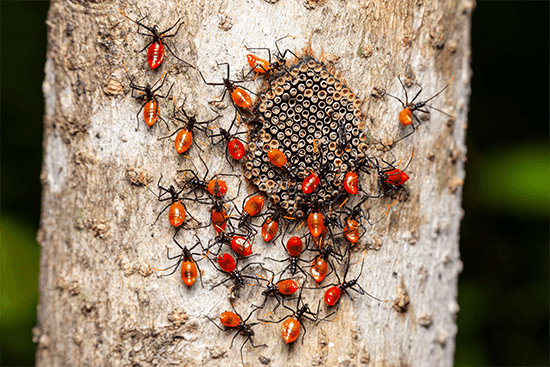
Incomplete, or hemimetabolous, metamorphosis consists of three stages: egg, nymph, and adult.10
- Appearance: The nymph resembles a smaller, wingless version of the adult.10
- Development: As the nymph grows through a series of molts, it gradually develops adult features, such as wings and reproductive organs, which appear externally.1011
- Examples: This process is common in insects such as grasshoppers, termites, and true bugs.1011
Complete Metamorphosis (Holometabolous)
Complete, or holometabolous, metamorphosis involves four distinct stages: egg, larva, pupa, and adult.1012
- Appearance: The larva looks entirely different from the adult and is specialized for feeding and growth.1011
- Transformation: The insect enters an inactive, nonfeeding pupa stage. During this time, larval tissues are broken down and reorganized into adult structures.10
- Examples: This cycle is characteristic of beetles, butterflies, moths, flies, and wasps.1011
Sources
- wheel bug: Top Questions — Encyclopædia Britannica
- wheel bug — Merriam-Webster
- wheel bug — Encyclopædia Britannica
- assassin bug — Encyclopædia Britannica
- ambush bug — Encyclopædia Britannica
- heteropteran - Annotated classification — Encyclopædia Britannica
- assassin bug — Merriam-Webster
- scorpion - Food and feeding — Encyclopædia Britannica
- heteropteran - Food habits — Encyclopædia Britannica
- Metamorphosis — Encyclopædia Britannica
- insect - Types of metamorphosis — Encyclopædia Britannica
- Coleoptera - General features — Encyclopædia Britannica
- heteropteran - Metamorphosis — Encyclopædia Britannica
Published on · 3 min read