Bushveld
The Bushveld is a natural region in southern Africa characterized by its savanna vegetation, which includes acacia trees, baobab trees, thornbushes, and tall…
What is Bushveld?
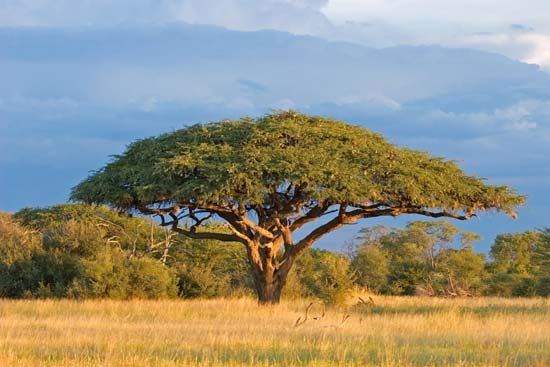
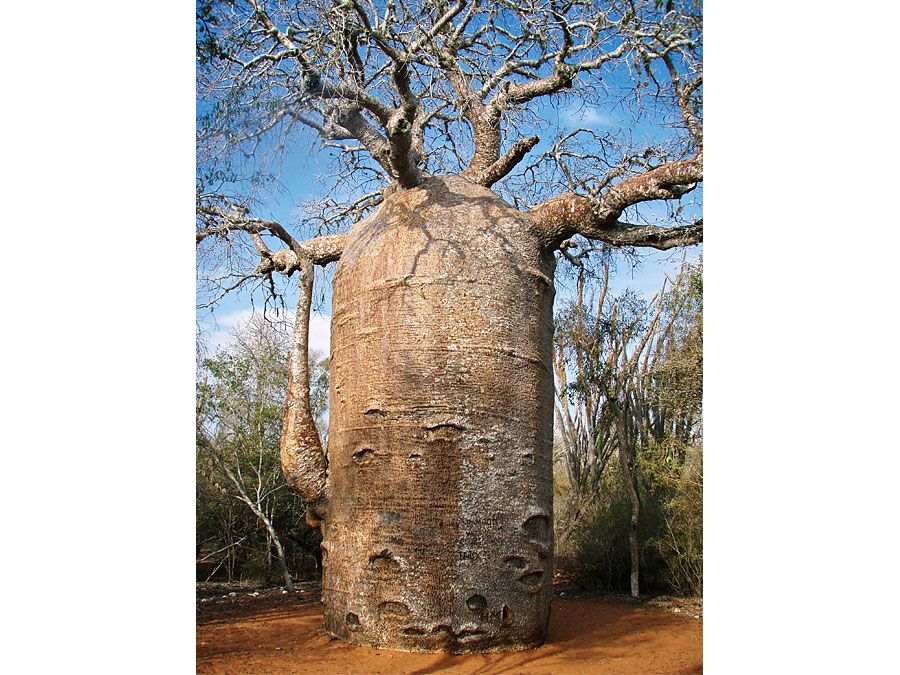
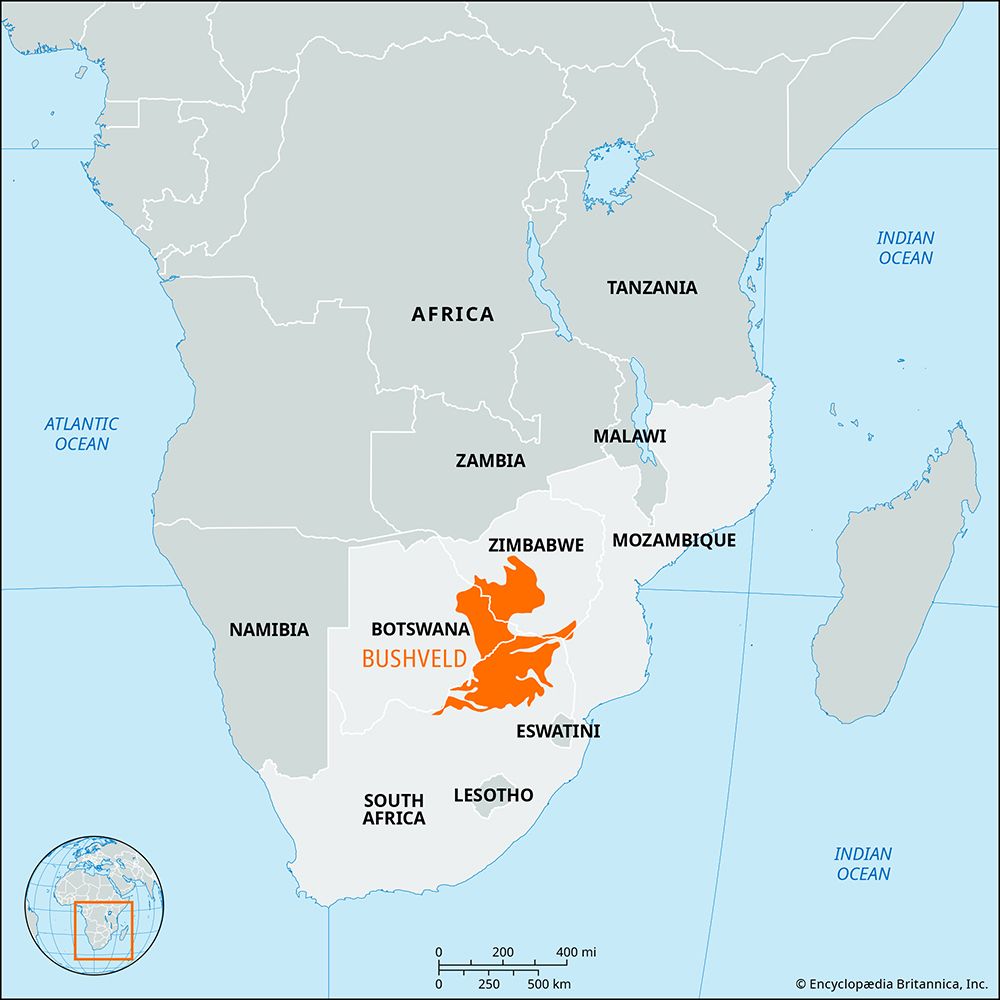
The Bushveld is a natural region in southern Africa characterized by its savanna vegetation, which includes acacia trees, baobab trees, thornbushes, and tall grasses. Situated at an elevation of approximately 2,500–4,000 feet (800–1,200 meters), the region is centered in Limpopo province, South Africa, and extends into Botswana, Eswatini, Mozambique, Zimbabwe, and northern KwaZulu-Natal. It is a moderately dry area where herding serves as the primary economic activity.12
It is important to distinguish this geographic region from the Bushveld Complex, a massive Proterozoic igneous intrusion located in South Africa. Formed nearly 2.1 billion years ago, this geological feature is the world’s largest repository of magmatic ore deposits, containing significant quantities of platinum, iron, titanium, vanadium, nickel, and chromite.3
What animals are commonly found in the Bushveld?
The Bushveld is home to a diverse array of wildlife, though many large mammal populations are now primarily found within protected wildlife reserves due to historical habitat loss and human settlement.24
Commonly found animals in the region include:
- Large Mammals: The area supports various large species, including elephants, rhinoceroses, hippopotamuses, zebras, giraffes, and baboons.24
- Antelope: A wide variety of antelope species inhabit the region, such as impala, kudu, wildebeest, duiker, waterbuck, and reedbuck2.4
- Predators: Carnivores in the region include lions, leopards, jackals, and smaller cats like the caracal.24
- Smaller Mammals: Mongooses and various monkeys are also frequently encountered2.4
- Reptiles and Birds: The region hosts a wide distribution of snakes, and crocodiles are common in local rivers crocodiles are common in local rivers. Birdlife is abundant, featuring species such as hornbills, barbets, weavers, the lilac-breasted roller, and the purple-crested loerie.24
How does the Bushveld Igneous Complex impact the economy?
The Bushveld Complex serves as a cornerstone of the South African economy due to its status as the world’s largest repository of magmatic ore deposits. Formed approximately 2.1 billion years ago, this massive geological feature covers 66,000 square kilometers and provides a vast supply of essential industrial and precious metals.6
The economic impact of the complex is driven by the extraction of several critical resources:
- Platinum-Group Metals: The complex is the world’s largest deposit of platinum, making South Africa a leading global producer.36
- Industrial Metals and Minerals: It contains significant quantities of iron, titanium, vanadium, nickel, and chromite3.
By housing these high-value minerals within its stratiform layers, the Bushveld Complex functions as a vital engine for mining and export, significantly influencing both the regional and global supply chains for these materials.36
What are the main differences between the Bushveld and the Highveld?
The Highveld and the Bushveld are distinct natural regions in southern Africa, differing primarily in their elevation, vegetation, and geological composition.
Elevation and Geography
- Highveld: This region consists of high-plateau country, generally lying between 4,000 and 6,000 feet (1,200 to 1,800 meters) above sea level. It is characterized by a remarkably even surface of flat plains, occasionally broken by relict mountains and steep-sided hills known as kopjes.7
- Bushveld: Located at a lower elevation, the Bushveld typically ranges from 2,500 to 4,000 feet (800 to 1,200 meters) above sea level. It is centered in South Africa’s Limpopo province but extends into several neighboring countries.2
Vegetation
- Highveld: The characteristic vegetation is grassland, dominated by species of red grass. Trees are sparse compared to other regions.18
- Bushveld: Often described as “thornbush field,” this region is a savanna characterized by a mix of tall grasses and trees, including acacia, baobab, and various thornbushes.2
Geology
- Highveld: Much of the region is underlain by sedimentary strata of the Karoo System, which includes coal-bearing layers.7
- Bushveld: This region is underlain by the unique Bushveld Complex, a massive geological formation renowned for its vast wealth of rare minerals, including platinum and other precious metals.7
Sources
- Bushveld — Encyclopædia Britannica
- South Africa - Flora and fauna — Encyclopædia Britannica
- Precambrian - Layered igneous intrusions — Encyclopædia Britannica
- Eswatini - Plant and animal life — Encyclopædia Britannica
- artiodactyl - Food habits — Encyclopædia Britannica
- platinum group - Ores — Encyclopædia Britannica
- veld - Physiography — Encyclopædia Britannica
- veld - Plant life — Encyclopædia Britannica
- Zimbabwe - Plant and animal life — Encyclopædia Britannica
Published on · 3 min read