Pheasant’s-eye
Pheasant’s-eye refers primarily to Adonis annua, an annual herbaceous plant belonging to the buttercup family (Ranunculaceae). Native to Eurasia, this plant…
What is pheasant’s-eye?
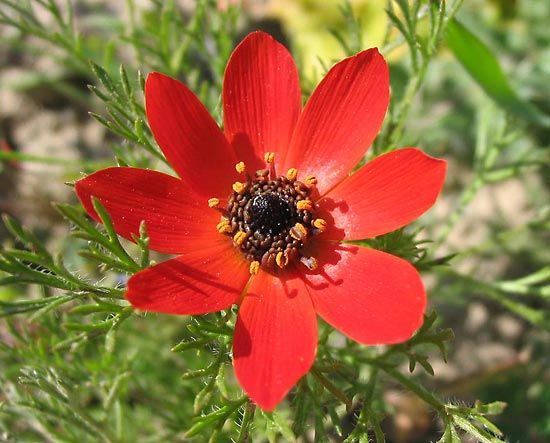
Pheasant’s-eye refers primarily to Adonis annua, an annual herbaceous plant belonging to the buttercup family (Ranunculaceae). Native to Eurasia, this plant typically grows between 20 and 40 cm (8 to 16 inches) tall and is widely cultivated in garden borders or for use as cut flowers. It is best known for its distinctive small, deep red flowers that feature prominent dark centers.12
The term is also occasionally used to describe other plants, including the pheasant’s-eye pink and the poet’s narcissus2.
What other plants belong to the buttercup family?
The Ranunculaceae family, commonly known as the buttercup family, comprises approximately 2,252 species of flowering plants distributed primarily across temperate and subtropical regions. These plants are predominantly herbaceous and are widely recognized for their showy flowers, which typically feature five or more petals and numerous stamens and pistils.34
Beyond the buttercup (Ranunculus), the family includes a diverse array of popular wildflowers and garden ornamentals, such as:
- Anemone
- Baneberry
- Bugbane
- Clematis
- Columbine
- Globeflower
- Goldenseal
- Hellebore (including the Christmas rose)
- Hepatica
- Larkspur
- Love-in-a-mist
- Marsh marigold
- Meadow rue
- Monkshood
- Mousetail
- Pheasant’s-eye
- Winter aconite34
Why is the genus named after the mythological figure Adonis?
The genus Adonis is named after the mythological figure Adonis, a youth in Greek legend renowned for his remarkable beauty. In mythology, Adonis is central to themes of death and resurrection, representing the decay of nature during winter and its revival in the spring. Because of this association, he is viewed by scholars as an ancient spirit of vegetation.6
The naming of the genus reflects this connection to the natural cycle of growth and renewal. Much like the myth of Hyacinthus, where a flower is said to have sprung from the blood of a fallen youth, the naming of botanical genera after such figures often highlights their symbolic link to the seasonal life cycle of plants.67
What are the differences between annual and perennial plants?
The primary difference between annual and perennial plants lies in the duration of their life cycles and their survival strategies across growing seasons.
Annual Plants
An annual is a plant that completes its entire life cycle—from germination to seed production and death—within a single growing season.1011
- Survival: The only part of an annual that persists from one season to the next is the dormant seed.11
- Examples: Many important food crops, such as cereal grains, peas, and lettuce, as well as garden flowers like marigolds and zinnias, are annuals.11
Perennial Plants
A perennial is a plant that persists for several years.1213
- Survival: These plants regrow and rebloom year after year. In cold climates, herbaceous perennials often survive winter by storing energy in underground structures like bulbs, rhizomes, or tubers, while their aboveground parts die back.12
- Examples: All trees and shrubs are perennials, as are garden favorites like chrysanthemums and columbines.12
Some plants, such as tomatoes, are perennials in their native tropical climates but are grown as annuals in temperate zones because they cannot survive the cold.13
Sources
- pheasant’s-eye — Encyclopædia Britannica
- pheasant's-eye — Merriam-Webster
- Ranunculaceae — Encyclopædia Britannica
- buttercup — Encyclopædia Britannica
- list of plants in the family Ranunculaceae — Encyclopædia Britannica
- Adonis — Encyclopædia Britannica
- Adonis — Merriam-Webster
- adonin — Merriam-Webster
- Hyacinthus — Encyclopædia Britannica
- Is That Plant 'Perennial' or 'Annual'? — Merriam-Webster
- Perennial — Encyclopædia Britannica
- Annual — Encyclopædia Britannica
- life span - Perennials — Encyclopædia Britannica
Published on · 2 min read