Velvetleaf
Velvetleaf (Abutilon theophrasti) is an annual, hairy plant belonging to the mallow family (Malvaceae). Native to southern Asia, it is cultivated in northern…
What is velvetleaf?
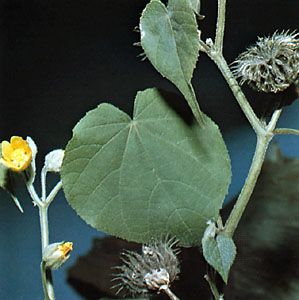
Velvetleaf (Abutilon theophrasti) is an annual, hairy plant belonging to the mallow family (Malvaceae). Native to southern Asia, it is cultivated in northern China as a source of fibre, where it is also known as China jute.12
In North America, however, the plant is widely naturalized and considered a serious agricultural weed. It typically grows between 0.6 and 2.4 metres (2 to 8 feet) tall and is characterized by its heart-shaped, downy leaves, five-petaled yellow flowers, and distinctive beaked seedpods. While the term “velvetleaf” can occasionally refer to other plants with soft, velvety foliage—such as certain vines, tree mallows, or mullein—it most commonly refers to A. theophrasti in an agricultural context.123
Why is velvetleaf considered a serious agricultural weed?
Velvetleaf (Abutilon theophrasti) is classified as a serious agricultural weed in the United States primarily because of its aggressive nature as a field invader. While it is valued in northern China as a source of fibre—earning it the name China jute—its rapid growth and ability to thrive in agricultural environments make it highly competitive with crops.13
As an annual plant that can reach heights of up to 2.4 metres (8 feet), velvetleaf competes with cultivated plants for essential resources such as sunlight, water, and soil nutrients. Its status as a “serious” weed stems from its capacity to establish dense populations in fields, which can significantly reduce crop yields and complicate agricultural management practices.13
What are some other common plants in the mallow family?
The mallow family (Malvaceae) is a diverse group of over 4,200 species, ranging from herbs and shrubs to large trees. Because of their economic and ornamental value, many members are widely recognized.45
Here are some common and economically important plants in the mallow family:
Food and Beverage Crops
- Cacao: The source of cocoa and chocolate.64
- Durian: Known for its large, spiny, and pungent fruit.4
- Kola nut: Used in the production of cola drinks.64
- Okra: A popular vegetable crop.64
Fiber and Wood Products
- Cotton: One of the most economically significant fiber plants.64
- Balsa: Valued for its lightweight wood.64
- Jute: Includes species like white jute and tossa jute, used for fiber.67
- Kapok: A fiber harvested from the seed pods of Ceiba species.64
Ornamentals and Garden Plants
- Hibiscus: A large genus known for showy flowers, including the rose of Sharon.67
- Hollyhock: A classic tall garden flower.65
- Linden (Basswood): Often planted as a street tree for its fragrant flowers.64
- Marsh mallow: Historically used to make confections.75
How is plant fiber used in manufacturing?
Plant fibers are essential raw materials in manufacturing, valued for their strength, flexibility, and sustainability as biodegradable alternatives to synthetic materials. Their use spans several major industries:10
Textiles and Cordage
Many plant fibers, particularly bast fibers like flax, hemp, and jute, are processed into yarn for woven cloth, ropes, and industrial fabrics. Cotton is the most prominent fiber in this category, undergoing mechanical processes like ginning, carding, and spinning to create everything from fine apparel to heavy-duty textiles.101112
Papermaking
Plant fibers are a primary constituent of paper. While wood pulp is common, many non-woody plants—such as cereal straws, bagasse (sugarcane residue), esparto grass, and bamboo—are used to produce various paper grades, including packaging, printing paper, and high-strength specialty papers.13
Bioplastics and Composites
Plant-derived sugars and starches are fermented to produce lactic acid, which is then polymerized into bioplastics like polylactic acid (PLA) for use in packaging and medical applications. Additionally, plant fibers are used as reinforcement in polymer-matrix composites, where they provide structural strength to plastic-based materials.1415
Sources
- velvetleaf — Encyclopædia Britannica
- velvetleaf — Merriam-Webster
- abutilon — Encyclopædia Britannica
- list of economically important members of the family Malvaceae — Encyclopædia Britannica
- mallow — Encyclopædia Britannica
- Malvales - Malvaceae , Cistaceae, and Muntingiaceae — Encyclopædia Britannica
- Malvaceae — Encyclopædia Britannica
- list of plants in the family Malvaceae — Encyclopædia Britannica
- Malvales — Encyclopædia Britannica
- Bast fiber — Encyclopædia Britannica
- cotton - Cotton fiber processing — Encyclopædia Britannica
- natural fibre — Encyclopædia Britannica
- papermaking - Natural fibres other than wood — Encyclopædia Britannica
- bioplastic — Encyclopædia Britannica
- plastic - Fibre reinforcement — Encyclopædia Britannica
Published on · 3 min read