Hollyhock
The hollyhock (Alcea rosea) is a tall, herbaceous flowering plant belonging to the mallow family (Malvaceae). Native to China, it is widely cultivated for…
What is hollyhock?
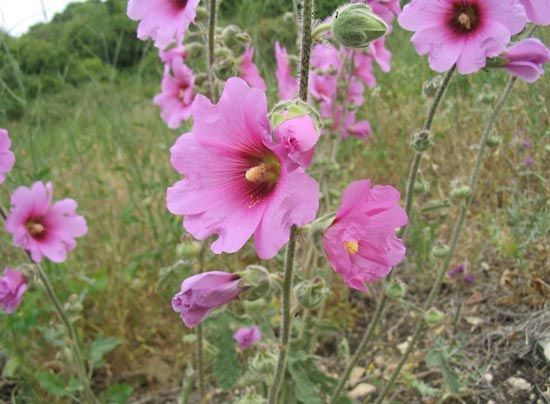
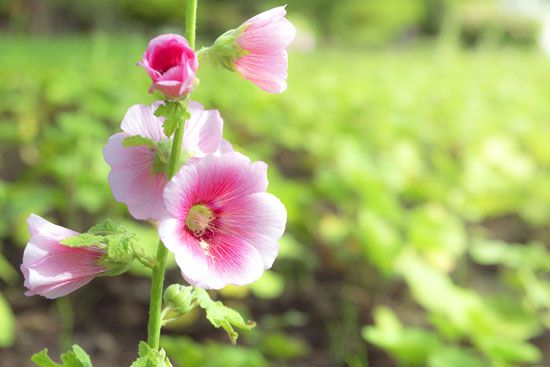
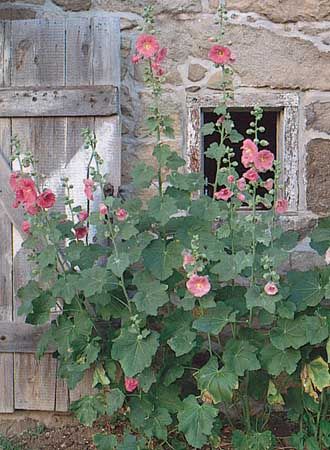
The hollyhock (Alcea rosea) is a tall, herbaceous flowering plant belonging to the mallow family (Malvaceae). Native to China, it is widely cultivated for its showy, large flowers, which typically bloom in shades of white, pink, red, or yellow along the upper portion of a stem that can reach heights of 1.5 to 2.7 meters (5 to 9 feet).12
The plant exists in annual, biennial, and perennial forms. As a perennial, it is a popular choice in ornamental horticulture, though it requires maintenance throughout the growing season. Because hollyhocks readily reseed, they are sometimes classified as invasive species when grown outside of their native range.13
What are the differences between annuals, biennials, and perennials?
Plants are categorized by the length of their life cycles and how they adapt to seasonal changes. The primary differences between annuals, biennials, and perennials are outlined below:
Annuals
Annuals are herbaceous plants that complete their entire life cycle—from germination to the production of seeds and eventual death—within a single growing season. Because they do not survive from one year to the next, the dormant seed is the only part of the plant that persists to ensure the next generation. Common examples include corn, lettuce, and marigolds.45
Biennials
Biennials require two growing seasons to complete their life cycle.6
- First Season: The plant focuses on vegetative growth, producing roots, stems, and leaves.65
- Second Season: The plant uses stored energy to produce flowers, fruits, and seeds before dying.65 Carrots and parsley are well-known examples.65
Perennials
Perennials are plants that persist for several years. While trees and shrubs are woody perennials, many herbaceous perennials survive winter by dying back to the ground and regrowing from underground structures like bulbs, rhizomes, or tubers. Examples include hollyhocks, chrysanthemums, and asparagus.75
What other plants belong to the mallow family?
The mallow family (Malvaceae) is a diverse group comprising approximately 243 genera and over 4,225 species of trees, shrubs, and herbaceous plants distributed worldwide. Beyond the hollyhock, the family includes many plants of significant economic and ornamental value.910
Economically Important Members
Many members of the Malvaceae family are cultivated for their fibers, food products, or fragrances:
- Fiber and Wood: Cotton (Gossypium), balsa, kapok, kenaf, and various species of jute (such as white jute and tossa jute) are primary sources of natural fibers and wood products.910
- Food Crops: This family provides essential food sources, including cacao, okra, durian, and kola nut.910
- Fragrances: The musk mallow (Abelmoschus moschatus) is widely cultivated for its aromatic seeds.1110
Ornamental Plants
Many species are grown for their showy, often five-petaled flowers:9
- Hibiscus: This genus includes the Chinese hibiscus and the rose of Sharon.910
- Trees and Shrubs: Notable examples include the baobab, silk-floss tree, linden (including basswood), and flannelbush.910
- Other Mallows: The family also encompasses the marsh mallow, velvetleaf, and various globe mallows.11
How do invasive species affect local ecosystems?
Invasive species are nonnative organisms that significantly disrupt the ecosystems they colonize. While many introduced species fail to survive in new environments, those that become invasive often possess a competitive advantage—such as a lack of natural predators—allowing them to establish breeding populations and thrive.13
The ecological impacts of these invasions are profound:
- Biodiversity Loss: Invasive species often outcompete native organisms for food, living space, and other essential resources. Over time, they can replace native species, leading to localized extinction.13
- Disruption of Food Chains: Invasive predators can decimate native prey populations, while invasive plants, such as kudzu, can form dense monocultures that deprive native flora of sunlight.1314
- Disease Transmission: Invasive species frequently serve as vectors for parasites and pathogens, spreading diseases to which native populations may have no resistance.1314
- Economic and Physical Damage: Beyond ecological harm, these species can cause significant economic damage to biological resources and infrastructure, such as clogging water-intake pipes with zebra mussels.1314
Preventing new introductions remains the most effective way to protect biodiversity, though habitat restoration efforts are increasingly used to remove established invaders and reintroduce native species.15
Sources
- hollyhock — Encyclopædia Britannica
- horticulture - Herbaceous perennials — Encyclopædia Britannica
- hollyhock — Merriam-Webster
- Biennial — Encyclopædia Britannica
- Perennial — Encyclopædia Britannica
- Annual — Encyclopædia Britannica
- Angiosperm - General features — Encyclopædia Britannica
- Plant development - Seasonal adaptations — Encyclopædia Britannica
- list of plants in the family Malvaceae — Encyclopædia Britannica
- Malvales — Encyclopædia Britannica
- mallow — Encyclopædia Britannica
- list of economically important members of the family Malvaceae — Encyclopædia Britannica
- invasive species — Encyclopædia Britannica
- invasive species - Solutions — Encyclopædia Britannica
- invasive species - A global problem — Encyclopædia Britannica
Published on · 3 min read