Florida Bay
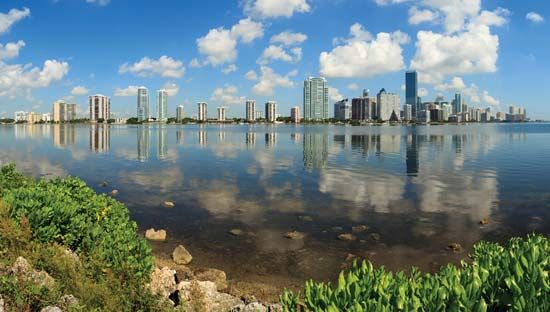
Florida Bay is a shallow, triangular-shaped body of water located at the southern tip of Florida, situated between the Gulf of Mexico and Biscayne Bay.…
What is Florida Bay?
Florida Bay is a shallow, triangular-shaped body of water located at the southern tip of Florida, situated between the Gulf of Mexico and Biscayne Bay. Covering approximately 850 square miles (2,200 square km), the bay is characterized by an average depth of only 4 to 5 feet (1.2 to 1.5 meters) and is dotted with numerous small islands.1
The area is partially sheltered from the Atlantic Ocean by the Florida Keys, which line its southern and eastern boundaries. Much of the bay is protected within Everglades National Park, serving as a vital habitat for species such as manatees and sea turtles, which rely on the bay’s extensive mangroves and sea grasses. Additionally, navigation channels have been dredged through the region to support the Intracoastal Waterwayastal Waterway](https://www.britannica.com/topic/Intracoastal-Waterway).1
What role do mangroves play in the Florida Bay ecosystem?
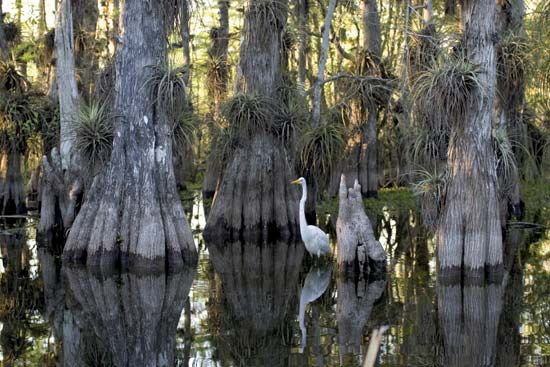
In the Florida Bay ecosystem, mangroves serve as essential keystone species that maintain the health and stability of the environment. Their role is multifaceted:
- Habitat Provision: Mangroves create critical nursery grounds for various marine species, including fish, crabs, and shrimp. These areas provide protected spaces for breeding, spawning, and hatching, which supports local biodiversity and fisheries.56
- Water Quality and Stabilization: The specialized root systems of mangroves, such as prop roots and pneumatophores, trap sediments and filter pollutants from the water. This process improves water clarity and quality, which is vital for the health of nearby seagrass beds and other marine life.56
- Coastal Protection: By acting as a buffer between marine and terrestrial communities, mangrove thickets protect shorelines from erosion, storm surges, and flooding](https://www.britannica.com/science/erosion-geology), storm surges, and flooding.56
In Florida, the ecosystem is primarily composed of the red mangrove and black mangroves, both of which are uniquely adapted to thrive in the saline, oxygen-poor soils of the bay.6
How does the Everglades affect the water quality of Florida Bay?
The Everglades historically acted as a natural filtration and distribution system, providing a steady, slow-moving flow of fresh water to Florida Bay. However, human-led water management—including the construction of canals, levees, and the drainage of land for agriculture—has fundamentally altered this relationship, often to the detriment of the bay’s water quality.7
Key impacts include:
- Nutrient Enrichment: Runoff from agricultural areas, particularly those converted for sugarcane production, carries excess nutrients into the ecosystem. This enrichment triggers toxic algal blooms and the production of toxic algae, which can devastate local marine life and kill seagrass beds.78
- Altered Flow and Timing: Artificial water management has disrupted the natural seasonal cycle of water delivery. When water is diverted away from the Everglades to protect urban or agricultural areas, the bay is deprived of necessary fresh water, which can lead to hypersaline conditions that stress the estuary.72
- Contamination: Runoff has introduced high levels of organic mercury into the system, further degrading the habitat.7
Restoration efforts, such as the plan passed in 2000, aim to remove barriers and mimic natural water flow to improve the health of both the Everglades and Florida Bay.7
What are some of the endangered species found in Florida Bay?
Florida Bay serves as a vital habitat for several species that are protected under the Endangered Species Act. These include:
- American Crocodile: This species inhabits the brackish and marine intertidal environments of the bay. While it has made progress in recovery, it remains listed as an endangered species in the United States due to threats such as habitat loss and illegal hunting.912
- Manatee: Florida manatees frequent the bay’s waters. Although they are currently classified as a threatened species rather than endangered, they remain protected under federal law to prevent harassment and harm from boat collisions, which are a leading cause of mortality.131
- Sea Turtles: Various species of sea turtles utilize the bay’s seagrass beds and mangrove-lined waters as essential habitat.91
Additionally, the broader Everglades ecosystem, which encompasses much of Florida Bay, supports other endangered wildlife such as the Florida panther and the wood stork, as well as the Cape Sable seaside sparrow, which is significantly impacted by water management practices.914
Sources
- Florida Bay — Encyclopædia Britannica
- Everglades — Encyclopædia Britannica
- Biscayne Bay — Encyclopædia Britannica
- conservation - Pollution — Encyclopædia Britannica
- mangrove: Top Questions — Encyclopædia Britannica
- mangrove — Encyclopædia Britannica
- Everglades - Development of the Everglades — Encyclopædia Britannica
- Lake Okeechobee — Encyclopædia Britannica
- Everglades - Natural environment — Encyclopædia Britannica
- lagoon - Water temperature and salinity — Encyclopædia Britannica
- salinity — Encyclopædia Britannica
- American crocodile — Encyclopædia Britannica
- Why is it illegal to touch a manatee? — Encyclopædia Britannica
- conservation - Flood control — Encyclopædia Britannica
- manatee — Encyclopædia Britannica
Published on · 3 min read