Lancaster Sound
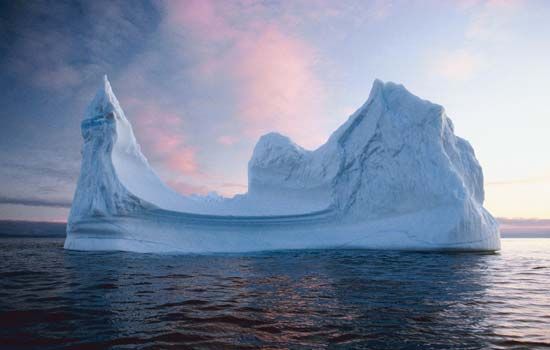
Lancaster Sound is the western arm of Baffin Bay, located in the Nunavut territory of Canada. Stretching 200 miles (320 km) long and 40 miles (64 km) wide…
What is Lancaster Sound?
Lancaster Sound is the western arm of Baffin Bay, located in the Nunavut territory of Canada. Stretching 200 miles (320 km) long and 40 miles (64 km) wide, it lies between Devon Island to the north and Baffin Island to the south, eventually joining the Barrow Strait near Somerset Island.1
This waterway is historically and geographically significant as a vital component of the Northwest Passage, serving as a passage for all feasible routes through the Canadian Arctic Archipelago that connect the Atlantic and Pacific oceans. The sound was discovered in 1616 by the English navigator William Baffin, who named it in honor of Sir James Lancaster, the promoter of his expedition.1
What is the history of the search for the Northwest Passage?
The search for the Northwest Passage—a sea route connecting the Atlantic and Pacific oceans through the Arctic Archipelago—represents centuries of maritime exploration and hardship.
Early Exploration
Following the 15th-century disruption of overland trade routes to the East, Western explorers sought a westward path around the American landmass. Early efforts were marked by failure and tragedy. Notable figures such as John Cabot, Sir Martin Frobisher, and Henry Hudson attempted to navigate the icy channels, often encountering impassable ice or dead ends like Hudson Bay.
The 19th-Century Crisis
The quest reached a tragic nadir with the Franklin expedition. In 1845, Sir John Franklin and 128 men vanished while seeking the passage. The subsequent search for the lost crew significantly expanded geographical knowledge of the Arctic. In 1854, Robert McClure completed the first one-way transit by combining sea travel with overland sledging.
Success and Modern Context
The passage was finally conquered by sea in 1903–1906 by Roald Amundsen, who navigated the route in the Gjøa. Today, global warming has reduced summer sea ice, increasing interest in the route for commercial shipping, though it remains a complex issue involving sovereignty and environmental regulation.
What types of marine animals live in the Canadian Arctic?
The Canadian Arctic supports a diverse array of marine life, ranging from microscopic algae to large mammals. These species are often part of a specialized food web anchored by sea ice, where algae—primarily diatoms—grow within the ice to support invertebrates like worms, copepods, and amphipod crustaceans.5
Marine Mammals
Warm-blooded mammals dominate the macrofauna of the region.5
- Whales: Species such as the beluga, narwhal, and bowhead whale are characteristic of Arctic waters. Killer whales are also frequent visitors of Arctic waters. Killer whales are also frequent visitors.5
- Seals and Walruses: The region is home to ringed seals and bearded seals, as well as migrant harp seals and hooded seals. Walruses are also found in northern areas.56
- Polar Bears: While they traverse land and ice, polar bears are considered essentially aquatic animals, as they rely on the sea ice to hunt seals.57
Fish and Birds
- Fish: Arctic fish species are relatively limited in number. Common species include the arctic char, polar cod, and arctic cod. Other species like sculpin, capelin, and halibut are also present.56
- Marine Birds: During the summer, the region hosts abundant seabirds, including the auk family (such as murres and guillemots), various gulls, terns, jaegers, and sea ducks like eiders and scoters.5
Who was William Baffin and what were his other discoveries?
William Baffin (c. 1584–1622) was an English navigator renowned for his contributions to Arctic exploration and his pioneering work in maritime science. He is perhaps best known for his 1615 determination of longitude at sea by observing the occultation of a star by the Moon, which is considered the first recorded instance of this technique.11
His primary discoveries and explorations include:
- Baffin Bay and Surrounding Sounds: In 1616, while piloting the Discovery, Baffin reached the head of Baffin Bay (78° N). During this voyage, he discovered and named Smith Sound, Jones Sound, and Lancaster Sound.1112
- Hudson Strait and Southampton Island: In 1615, alongside Captain Robert Bylot, he explored the Hudson Strait and the northeast coast of Southampton Island.1112
- Surveys in the East: Later in his career, while in the service of the East India Company, Baffin conducted significant surveys of the Red Sea and the Persian Gulf.11
Baffin died in 1622 during an Anglo-Persian attack on Qeshm Island11.
Sources
- Lancaster Sound — Encyclopædia Britannica
- Northwest Passage — Encyclopædia Britannica
- European exploration - The northern passages — Encyclopædia Britannica
- Franklin expedition: Top Questions — Encyclopædia Britannica
- Arctic - Marine fauna — Encyclopædia Britannica
- Baffin Bay — Encyclopædia Britannica
- sea ice - The emerging impacts of recent changes to sea ice — Encyclopædia Britannica
- Arctic - Animals of the land and fresh water — Encyclopædia Britannica
- Polar ecosystem - Biota of the Arctic — Encyclopædia Britannica
- Arctic - Climate of the Arctic — Encyclopædia Britannica
- William Baffin — Encyclopædia Britannica
- Arctic - Early voyages of exploration — Encyclopædia Britannica
Published on · 3 min read