Tasmanian Cedar
Tasmanian cedar refers to any of three species of evergreen conifers belonging to the genus Athrotaxis within the cypress family. These trees are native to…
What is Tasmanian cedar?
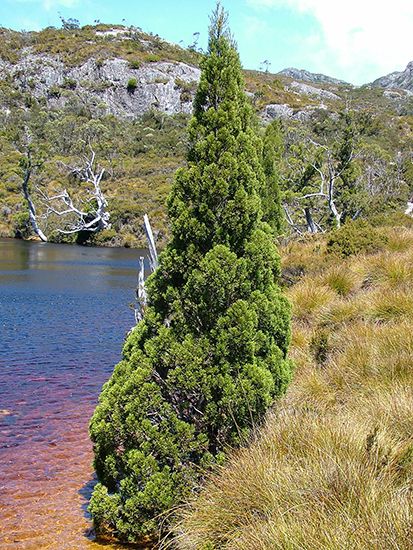
Tasmanian cedar refers to any of three species of evergreen conifers belonging to the genus Athrotaxis within the cypress family. These trees are native to the temperate rain forests of Tasmania.1
Two of these species are smaller trees, typically reaching heights of 6 to 12 metres (20 to 40 feet), and are sometimes cultivated as ornamentals. The third species, known as the King William pine, is a significant timber tree that can grow up to 30 metres (100 feet) tall with a circumference of 2.7 metres (9 feet). Its foliage consists of dark green, leathery leaves that contain volatile oils.1
What are the main characteristics of the cypress family?
The Cupressaceae family, commonly known as the cypress family, consists of 30 genera and 133 species of evergreen trees and shrubs distributed globally.2
Key characteristics include:
- Foliage: Leaves are typically opposite or whorled, often appearing in pairs or threes. On mature plants, they are usually narrow and scalelike, pressed against flattened branchlets, while juvenile or transitional leaves may be awl-shaped.23
- Reproductive Structures: These plants produce cones that are terminal and woody, featuring opposite or whorled scales. Each scale consists of a fused bract and a scale, with erect ovules.2
- Economic Utility: Many members are valued as timber or ornamental plants, including arborvitae, juniper, and cypress. They are also known for containing useful resins, tannins, and volatile oils.23
- Classification: Molecular studies have confirmed that the traditional Cupressaceae and the formerly separate family Taxodiaceae form a single natural group.2
How do temperate rain forests support unique plant life?
Temperate rainforests support unique plant life through a combination of high moisture, mild temperatures, and complex structural niches. These biomes, located primarily in middle latitudes along western coasts, receive abundant annual precipitation in the form of heavy rain and coastal fog, which sustains lush, dense vegetation.5
The environment supports a diverse array of plant life through several key factors:
- Structural Complexity: These forests are characterized by towering trees, including massive conifers like redwoods, firs, and spruces, which create a dense canopy. This structure provides various microhabitats for smaller plants.5
- Epiphytic Growth: Beneath the canopy, ferns and mosses abound. Many of these plants act as epiphytes, growing on other plants for physical support to access light and nutrients from organic debris, while absorbing moisture directly from the air and rain.56
- Carbon Storage: The high biomass—consisting of living and fallen trees, mosses, and fungi—creates a nutrient-rich environment. This organic matter, along with the soil, serves as a vital carbon store, supporting the continued growth of old-growth forests.5
- Regional Adaptation: Plant communities vary by region, such as the monkey puzzle tree in South America or the myrtle beech and Huon pine in Tasmania, which have adapted to specific local climatic and topographic conditions.57
What makes King William pine wood valuable for timber?
The King William pine (Athrotaxis selaginoides), also known as a Tasmanian cedar, is a significant timber tree native to the temperate rainforests of Tasmania. It is the largest of the three species in the genus Athrotaxis, capable of reaching heights of 30 metres (100 feet) and circumferences of up to 2.7 metres (9 feet).1
While the provided search results identify the King William pine as a timber tree, they do not specify the particular characteristics that make its wood valuable for commercial use. The available information notes that the tree’s leaves contain volatile oils, but it does not detail the physical or mechanical properties of the timber itself.1
Sources
- Tasmanian cedar — Encyclopædia Britannica
- Cupressaceae — Encyclopædia Britannica
- cypress — Encyclopædia Britannica
- Cupressaceae — Merriam-Webster
- Tropical rainforest - Environment — Encyclopædia Britannica
- Temperate rainforest — Encyclopædia Britannica
- Epiphyte — Encyclopædia Britannica
- Tasmanian Wilderness — Encyclopædia Britannica
- Tasmania - Plant and animal life — Encyclopædia Britannica
- Tropical rainforest - General structure of the rainforest — Encyclopædia Britannica
- Tropical rainforest - Flora — Encyclopædia Britannica
- King William pine — Merriam-Webster
Published on · 3 min read