Bismarck Range
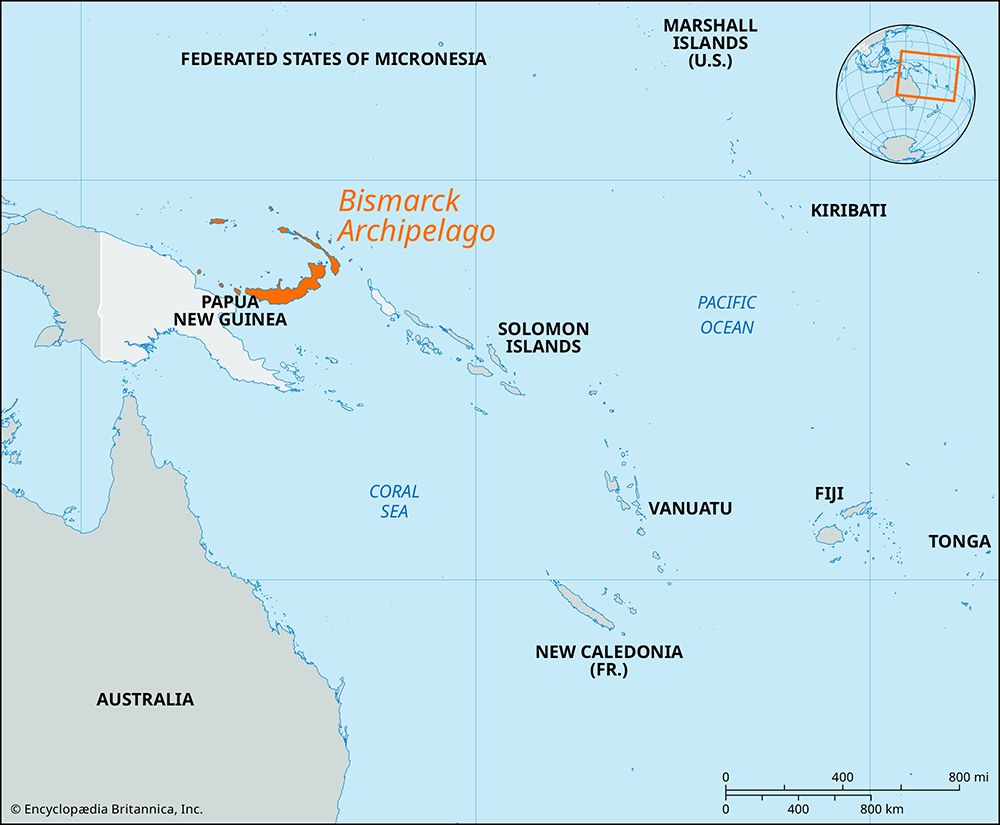
The Bismarck Range is a mountain range located in the northeastern segment of the central highlands of Papua New Guinea in the southwestern Pacific Ocean.…
What is Bismarck Range?
The Bismarck Range is a mountain range located in the northeastern segment of the central highlands of Papua New Guinea in the southwestern Pacific Ocean. Situated northwest of the Owen Stanley Range, the mountains were visited by German explorer G.E. von Schleinitz in 1886 and named in honor of Otto von Bismarck.12
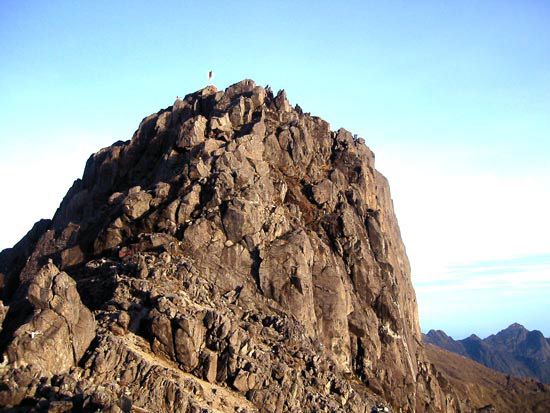
The range contains the highest peak in Papua New Guinea, Mount Wilhelm, which reaches an elevation of 14,793 feet (4,509 meters) and occasionally experiences snowfall on its summit. The mountains serve as a vital hydrological source, acting as the origin for the Ramu River as well as various tributaries of the Sepik and Purari rivers. Due to the high elevation, the region experiences cooler conditions compared to the tropical lowlands, with night frosts occurring at altitudes above 7,000 feet.123
Who was Otto von Bismarck and why were these mountains named after him?
Otto von Bismarck (1815–1898) was a prominent Prussian statesman who served as the prime minister of Prussia and became the founder and first chancellor of the German Empire in 1871. While he is noted for his skillful foreign policy that maintained peace in Europe for two decades, his domestic legacy is often criticized for his authoritarian tendencies.4
The Bismarck Range in Papua New Guinea was named in his honor following its 1886 exploration by the German explorer G.E. von Schleinitz. This naming reflects the historical period during which the northeastern quadrant of the island was administered by the German New Guinea Company and later the German imperial government. The range’s highest peak, Mount Wilhelm, was similarly named after one of Bismarck’s sons. This naming convention was also applied to other regional landmarks, such as the Bismarck Sea and the Bismarck Archipelago, which were under German control from the mid-1880s until 1914.156
What unique plants and animals live in the high-altitude zones of the New Guinea Highlands?
The high-altitude zones of the New Guinea Highlands, which rise above 3,300 feet (1,000 meters), host distinct ecological communities that shift significantly with increasing elevation.
Flora
As elevation increases, the vegetation transitions from lowland rainforest to specialized upland forests:
- Upland Forests: Above 3,300 feet, the forest composition changes as single-species stands become more common, dominated by trees such as oaks, beeches, red cedars, and pines.7
- Cloud and Moss Forests: Above 6,500 feet (2,000 meters), the landscape is characterized by cloud or moss forests. These environments are rich in conifers, tree ferns, and a diverse array of fungi and epiphytes, including mosses and orchids.7
Fauna
The Highlands support a unique biogeography shaped by the island’s long isolation and the absence of large mammals:
- Marsupials: The region is home to various marsupials, including tree kangaroos and the cuscus, a type of phalanger.78
- Birds: The Highlands are a center for birds-of-paradise, with some 40 species having evolved in the island’s isolated environment. Other notable birdlife includes cassowaries, parrots, bowerbirds, and megapodes.78
- Other Species: The fauna also includes echidnas, various reptiles such as snakes and tortoises, and a broad array of insects, including butterflies.78
How does the climate change as you move from the lowlands to the peaks of the Bismarck Range?
The climate of the Bismarck Range changes significantly with elevation, transitioning from tropical lowland conditions to much cooler highland environments.
Temperature and Elevation
In the lowlands, the climate is consistently tropical, with mean annual maximum temperatures ranging from 86 to 90 °F (30 to 32 °C) and minimums between 73 and 75 °F (23 and 24 °C). As you ascend into the Highlands, conditions become notably cooler. Above 7,000 feet (2,100 meters), night frosts are common, and daytime temperatures generally remain above 72 °F (22 °C) regardless of the season. At the highest peaks, such as Mount Wilhelm, temperatures are cold enough that the summits often retain snow.113
Precipitation and Airflow
Rainfall in the region is influenced by elevation, exposure, and wind systems, including the southeast trade winds and the northwesterly monsoon. While the Highlands receive rain throughout the year—totaling between 100 and 160 inches (2,500 to 4,000 mm)—the specific amount depends heavily on slope orientation. Mountains acting as barriers to airflow can cause extremely heavy rainfall on windward slopes, sometimes exceeding 300 inches (7,600 mm), while creating rain shadow effects on leeward sides.1110
Sources
- Bismarck Range — Encyclopædia Britannica
- Bismarck Range — Merriam-Webster
- Papua New Guinea - Climate of Papua New Guinea — Encyclopædia Britannica
- Otto von Bismarck — Encyclopædia Britannica
- Papua New Guinea - The colonial period — Encyclopædia Britannica
- Bismarck Sea — Encyclopædia Britannica
- Papua New Guinea - Plant and animal life — Encyclopædia Britannica
- Papua - Geography — Encyclopædia Britannica
- Mountain ecosystem - Flora — Encyclopædia Britannica
- Papua New Guinea - Relief — Encyclopædia Britannica
- Highland climate — Encyclopædia Britannica
Published on · 3 min read