Beardmore Glacier
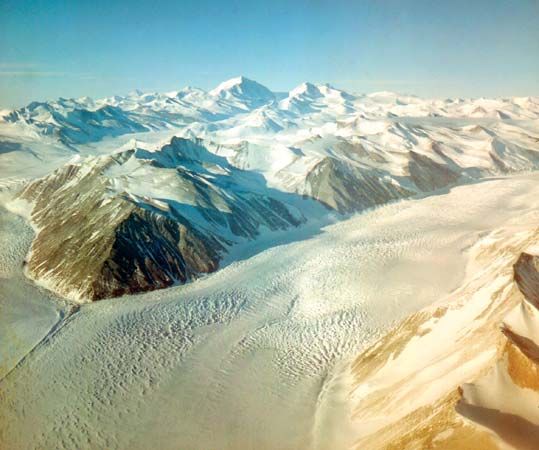
The Beardmore Glacier is one of the world's largest valley glaciers, located in central Antarctica. It spans 125 miles (200 km) in length and 25 miles in…
What is Beardmore Glacier?
The Beardmore Glacier is one of the world’s largest valley glaciers, located in central Antarctica. It spans 125 miles (200 km) in length and 25 miles in width, descending approximately 7,200 feet (2,200 meters) from the South Polar Plateau to the Ross Ice Shelf. This massive ice formation serves as a divide between the Queen Maud and Queen Alexandra ranges of the Transantarctic Mountains.12
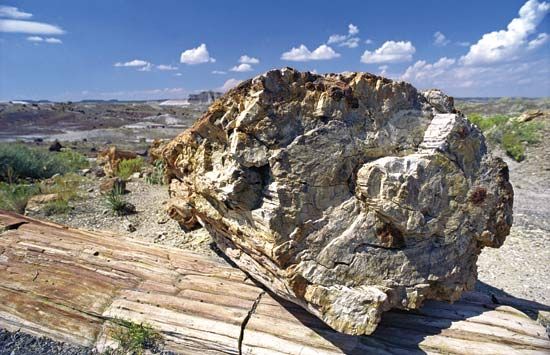
British explorers Ernest Shackleton and Robert Falcon Scott discovered the glacier during their respective expeditions toward the South Pole in 1908 and 1911. Scientific investigations of the glacier and its surrounding mountains have revealed significant fossils, including petrified wood, dinosaur remains, and coral, providing evidence that Antarctica once experienced a temperate climate.1
How did Antarctica once have a temperate climate?
Antarctica’s transition from a temperate, forested land to a frozen continent is primarily the result of plate tectonics and the subsequent isolation of the continent from warmer global ocean currents.34
Historical Climate
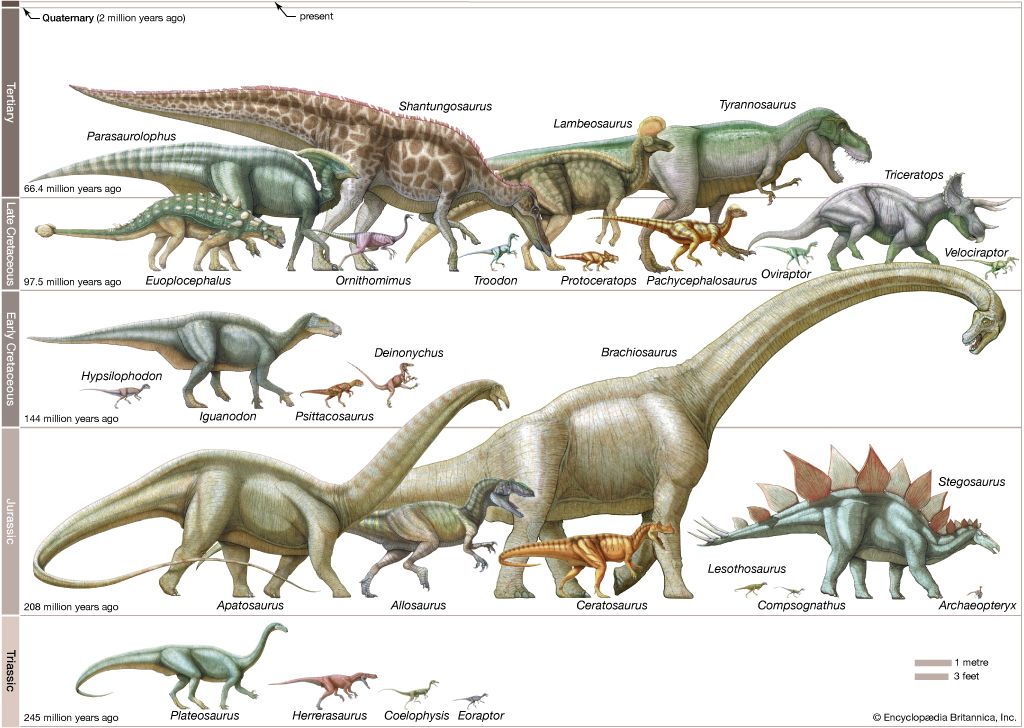
During the Mesozoic Era (approximately 252 to 66 million years ago), Antarctica was part of the supercontinent Gondwana. During this time, the continent supported dense forests of conifers and ferns, as well as diverse dinosaurs and [reptiles]. Even as late as 100 to 70 million years ago, polar surface water temperatures remained at or above 10 °C (50 °F), allowing forests to thrive at high latitudes.354
The Shift to Glaciation
The cooling of Antarctica was driven by several key geological and oceanographic changes:
- Continental Drift: As the continents dispersed following the breakup of Gondwana, the northward movement of Australia and South America opened a circumglobal seaway around Antarctica.4
- Oceanic Isolation: This opening allowed for the development of a vigorous circum-Antarctic current, which effectively isolated the continent from the warmer waters of the north.4
- Global Cooling: The loss of efficient latitudinal heat transport, combined with a long-term global temperature decline during the Cenozoic Era, initiated continental-scale glaciation approximately 35 million years ago.64
By the middle of the Miocene Epoch, about 13 million years ago, ice sheets covered most of the continent, locking Antarctica into the frigid climate observed today.6
What are the Transantarctic Mountains?
The Transantarctic Mountains are a massive mountain system that divides the Antarctic continent into two distinct regions: East Antarctica and West Antarctica10. Stretching over 2,000 miles (3,200 km) from Victoria Land to the Weddell Sea, the system reaches an elevation of 14,856 feet (4,528 meters) at Mount Kirkpatrick.10
Geologically, the range acts as a fault-block belt, or horst, separating the stable Precambrian shield of the east from the younger mobile belt of the west. While much of the region is obscured by ice sheets and glaciers, the mountains are notable for their rich fossil record, which includes remains of primitive amphibians, reptiles, and dinosaurs. Additionally, the area contains some of the world’s largest coal reserves, providing evidence of the continent’s temperate past.510
What challenges did Shackleton and Scott face on their expeditions?
The “heroic era” of Antarctic exploration was defined by extreme environmental hazards and logistical failures. Both Ernest Shackleton and Robert Falcon Scott faced life-threatening challenges during their expeditions.1112
Challenges Faced by Robert Falcon Scott
Scott’s 1910–12 Terra Nova expedition was marked by a series of equipment and supply failures. His reliance on motor sledges, ponies, and man-hauled sledges proved inadequate; the motors broke down, and the ponies had to be shot. During the return journey from the South Pole, the party faced:13
- Severe Weather: Exceptionally bad weather and prolonged blizzards trapped the men in their tents.13
- Resource Depletion: The team suffered from critically low food and fuel supplies.13
- Physical Exhaustion: The men grew progressively weaker, leading to the deaths of all five members of the polar party.13
Challenges Faced by Ernest Shackleton
Shackleton’s expeditions were characterized by the unpredictable nature of Antarctic ice and the struggle for survival after equipment loss.14
- Ice Entrapment: During the 1914–17 Imperial Trans-Antarctic Expedition, the Endurance was trapped and eventually crushed by pack ice, forcing the crew to drift on ice floes for months.1514
- Isolation and Survival: After reaching Elephant Island, the crew survived on limited rations of seal and penguin meat.14
- Dangerous Navigation: Shackleton and five others were forced to sail 800 miles across a treacherous ocean in a small whale boat to seek rescue.14
Sources
- Beardmore Glacier — Encyclopædia Britannica
- Beardmore — Merriam-Webster
- Antarctica - Antarctica and continental drift — Encyclopædia Britannica
- Tertiary Period - Paleoclimate — Encyclopædia Britannica
- Antarctica - Structural framework — Encyclopædia Britannica
- plate tectonics - Climate — Encyclopædia Britannica
- glacier - Climatic conditions — Encyclopædia Britannica
- What is the coldest temperature ever recorded on Earth? — Encyclopædia Britannica
- Antarctica - Glaciation — Encyclopædia Britannica
- Transantarctic Mountains — Encyclopædia Britannica
- Antarctica - Discovery of the Antarctic poles — Encyclopædia Britannica
- Ernest Shackleton — Encyclopædia Britannica
- Antarctica - The “ heroic era ” of exploration — Encyclopædia Britannica
- Robert Falcon Scott — Encyclopædia Britannica
- European exploration - Polar regions — Encyclopædia Britannica
- Franklin expedition: Top Questions — Encyclopædia Britannica
Published on · 3 min read