Lomami River
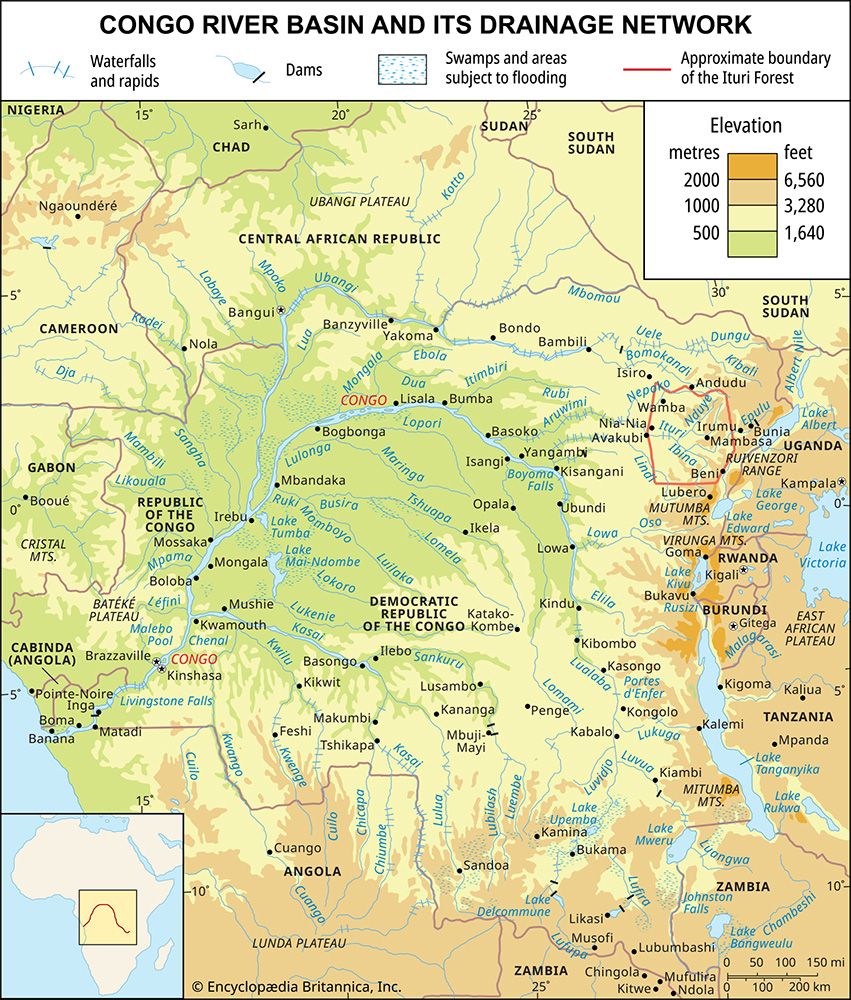
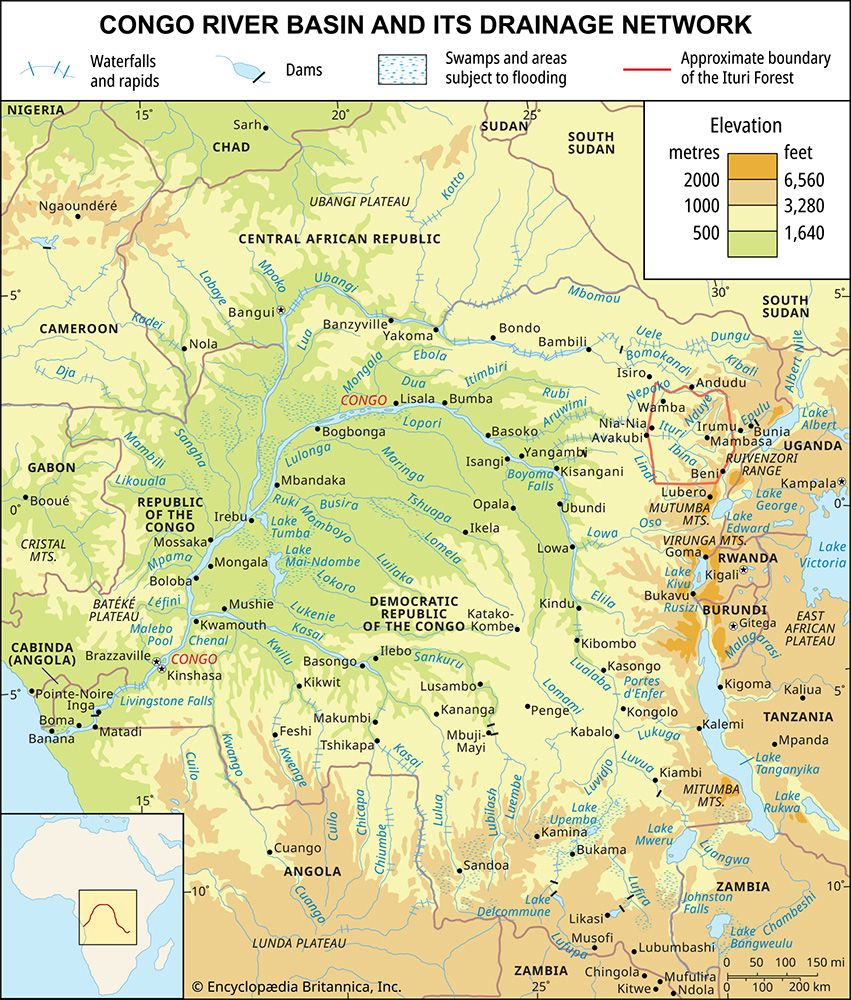
The Lomami River is a major river located in the Democratic Republic of the Congo (Kinshasa) and serves as a significant tributary of the Congo River.
What is Lomami River?
The Lomami River is a major river located in the Democratic Republic of the Congo (Kinshasa) and serves as a significant tributary of the Congo River.1
Rising in the Katanga highlands of the southern region of the country, the river flows northward for approximately 930 miles (1,500 km). It eventually joins the Congo River at Isangi, a location situated about 70 miles (113 km) west of Kisangani. The confluence of the Lomami and the Congo marks a point where the Congo River begins to widen significantly, reaching widths of more than 3.5 miles (5.5 km) downstream from that junction.12
What are the main characteristics of the Congo River basin?
The Congo basin is a vast, hydrographic depression in west-central Africa, covering more than 1.3 million square miles (3.4 million square km) and lying astride the Equator.32
Key Characteristics
- Geography: It is the world’s second-largest river basin, characterized by a central depression known as the cuvette (or “shallow bowl”). This area is surrounded by concentric slopes and is defined by a fan-shaped network of tributaries that flow into the main channel.42
- Geology: The cuvette contains deep Quaternary alluvial deposits and sediments dating back to the Precambrian era. The basin’s structure reflects a long-term tendency toward subsidence, accompanied by uplifting on its eastern edges, influenced by the Western Rift Valley.42
- Climate and Vegetation: The basin hosts the world’s second-largest rainforest. An equatorial climate supports dense evergreen forests in the central depression, which transition into belts of savanna and wooded grasslands as one moves away from the Equator.32
- Hydrology: The Congo River system is fed by year-round rains, resulting in a remarkably regular flow. Because the basin spans 20 degrees of latitude, the river’s regime is a complex integration of climatic influences from both sides of the Equator.5
How do tributaries like the Lomami River affect the flow of the Congo River?
Tributaries like the Lomami River play a vital role in shaping the Congo River by modifying its water levels and physical characteristics as they join the main stream.1
Each tributary contributes to the river’s complex hydrological regime, which is influenced by climatic patterns across 20 degrees of latitude. For example, the confluence of the Lomami at Isangi marks a distinct change in the Congo’s physical geography, where the river begins to widen significantly, often exceeding 3.5 miles (5.5 km) in width downstream from that point.15
The overall flow of the Congo is a cumulative result of these various inputs. While the basin is so vast that no single meteorological event can disrupt the steady movement of its waters, the timing of floods from different tributaries—such as the Ubangi River—can drastically alter annual fluctuations if they arrive at different times than expected. Consequently, the integration of these diverse tributary systems ensures that the Congo maintains a remarkably regular flow throughout the year, despite the varying seasonal conditions across its massive drainage basin.12
What kind of wildlife is found in the Congo River region?
The Congo River region is home to a rich and diverse array of wildlife, with species distribution largely determined by the transition between dense equatorial rainforests and surrounding savanna woodlands.84
Mammals
The forests are inhabited by primates, including chimpanzees, gorillas, and bonobos, the latter of which are found only in lowland rainforests south of the Congo River. Other forest dwellers include elephants (including the distinct African forest elephant), okapis, and various monkeys and baboons. Savanna regions support predators such as lions, leopards, hyenas, and cheetahs, alongside herbivores like buffaloes, antelopes, giraffes, and rhinoceroses. Aquatic mammals are rare but include hippopotamuses, otters, and the manatee.428
Aquatic and Reptilian Life
The river system is exceptionally rich in fish, with over 230 species identified in Malebo Pool alone. Common species include catfish, cichlids, and lungfish, the latter of which can survive in dried-up swamps by encysting in mucus. Crocodiles are the most prominent reptiles, joined by various turtles, snakes (such as pythons and cobras), and lizards.842
Birds and Insects
The region hosts over 265 indigenous forest bird species, including pelicans, parrots, sunbirds, and various herons and storks. Insects are incredibly numerous, ranging from diverse butterflies to tsetse flies, mosquitoes, ants, and termites.842
Sources
- Lomami River — Encyclopædia Britannica
- Congo River - Physiography — Encyclopædia Britannica
- Congo River: Top Questions — Encyclopædia Britannica
- Congo basin — Encyclopædia Britannica
- Congo River - Hydrology of the Congo River — Encyclopædia Britannica
- Africa - Congo basin — Encyclopædia Britannica
- Republic of the Congo - Drainage — Encyclopædia Britannica
- Congo River - Animal life — Encyclopædia Britannica
- Democratic Republic of the Congo - Plant and animal life — Encyclopædia Britannica
- Republic of the Congo - Plant and animal life — Encyclopædia Britannica
Published on · 3 min read