New Guinea
The indigenous peoples of New Guinea are primarily classified as Melanesian, with a cultural distinction often drawn between coastal and interior…
What indigenous people groups inhabit New Guinea, and what are their traditional ways of life?
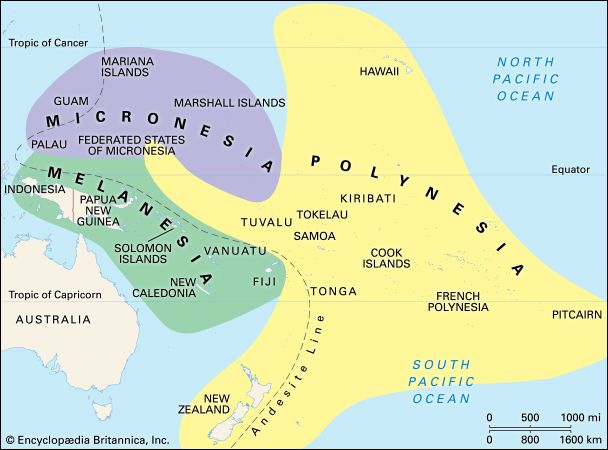
The indigenous peoples of New Guinea are primarily classified as Melanesian, with a cultural distinction often drawn between coastal and interior populations. Coastal communities historically engaged in maritime trade and fishing, while interior societies, such as the Asmat and Dani, maintained agrarian, noncommercial lifestyles in relative isolation.12
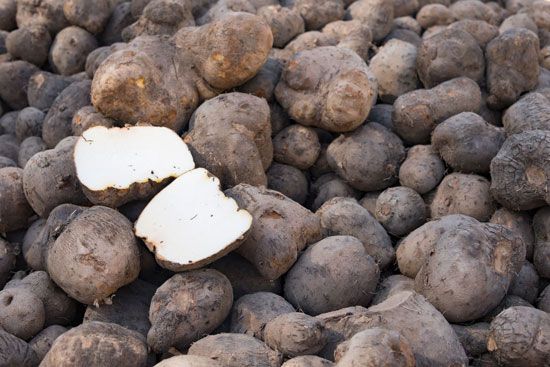
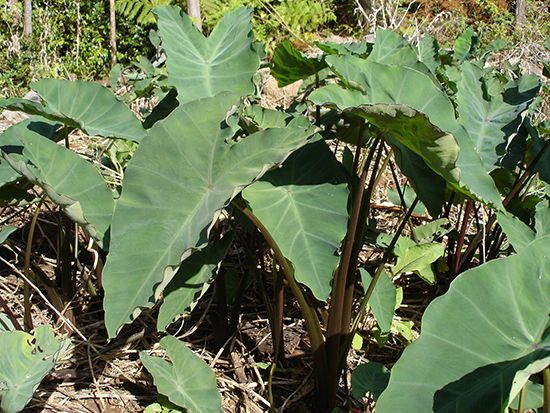
Traditional ways of life center on the extended family and the clan, which serves as the primary unit of social organization. Subsistence is historically based on slash-and-burn horticulture, focusing on crops like yams, taro, and sweet potatoes, supplemented by pig husbandry, hunting, and gathering.34
Social structures are typically patriarchal, even in matrilineal groups, and often feature the residential separation of men and women. While traditional customs and rituals remain significant, they have been heavily influenced by Christianity, colonial history, and modern economic development, leading to a complex blend of traditional kastom and contemporary Westernized influences.356
What is the geographical location and size of New Guinea?
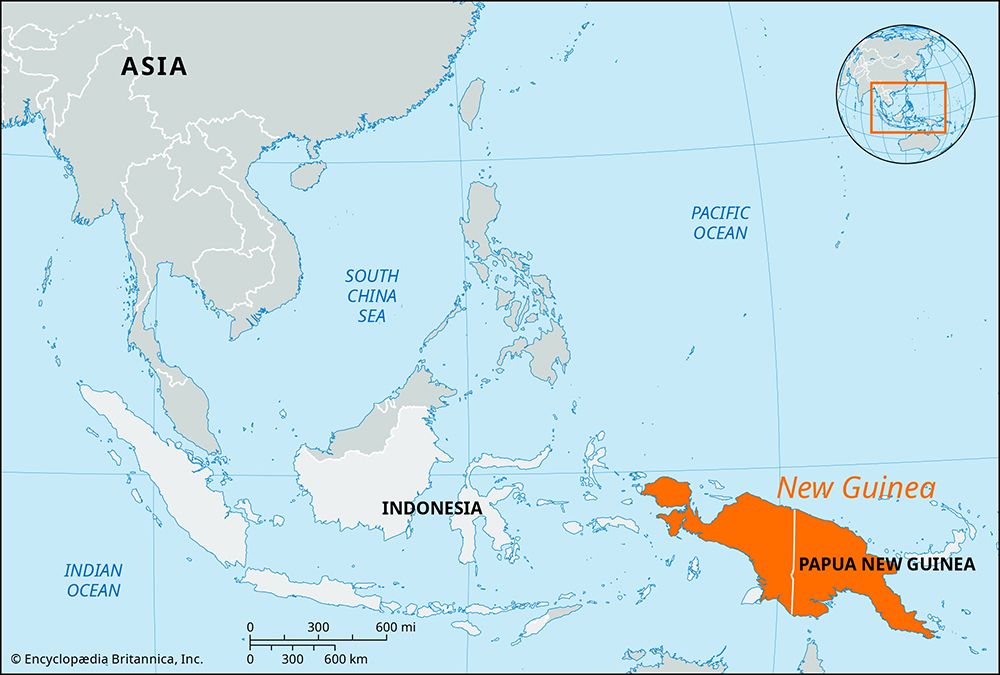
New Guinea is the second-largest island in the world, located in the eastern Malay Archipelago within the western Pacific Ocean, north of Australia.119
Geographical Dimensions
The island spans approximately 1,500 miles (2,400 km) in length from northwest to southeast and reaches a maximum width of about 400 miles (650 km). It covers a total area of 317,150 square miles (821,400 square km).9
Political Division
The island is administratively divided into two regions:
- Western Half: Comprises the Indonesian provinces of Papua and West Papua.9
- Eastern Half: Comprises the majority of the independent country of Papua New Guinea.9
The island is bounded by the Pacific Ocean to the north, the Bismarck and Solomon seas to the east, the Coral Sea and Torres Strait to the south, and the Arafura Sea to the southwest.9
What are some of the most significant plant and animal species found in New Guinea?
New Guinea possesses a unique and diverse biogeography, shaped by its long isolation and historical land connection to Australia.13
Plant Life
The island’s vegetation varies significantly by elevation and moisture:
- Coastal and Lowland: Mangrove swamps line the coast, transitioning inland to nipa palms and large stands of sago palms. Primary rainforest dominates up to 3,300 feet, featuring a rich variety of species including figs and orchids.1314
- Uplands: Above 3,300 feet, forests are dominated by oaks, beeches, red cedars, and pines.13
- High Altitudes: Above 6,500 feet, cloud forests emerge, characterized by conifers, tree ferns, mosses, and false beech.1314
Animal Life
New Guinea is notable for being almost devoid of large mammals, which has allowed for the evolution of distinct groups:13
- Birds: The island is famous for its approximately 40 species of birds-of-paradise, as well as cassowaries and various parrotsanimal/cassowary) and various parrots.1314
- Marsupials: Due to its former land bridge with Australia, the island hosts tree kangaroos, cuscuses, and echidnas.1312
- Other Fauna: The island also supports a rich variety of reptiles, crocodiles, and native freshwater fishes.13
What are the unique geographical features of New Guinea, including its mountains and rainforests?
New Guinea is defined by a dramatic and varied landscape shaped by the collision of the Australian Plate and the Pacific Plate.16
Mountainous Terrain
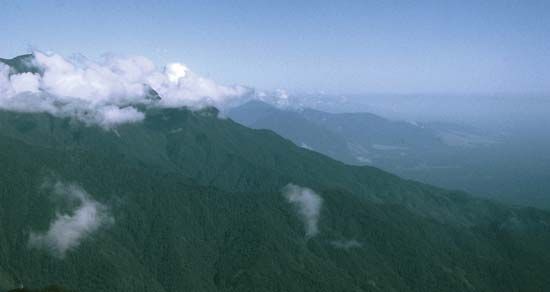
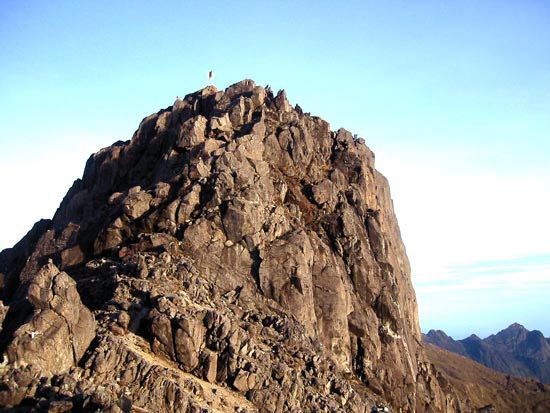
A massive, unbroken chain of mountains extends across the island from northwest to southeast. These highlands feature peaks exceeding 13,000 feet (4,000 meters), including Jaya Peak, which reaches 16,024 feet (4,884 meters) and is the highest island peak in the world. The range includes extinct volcanoes and fertile, enclosed upland basins that sit at elevations above 4,500 feet (1,370 meters). In the southeast, the Owen Stanley Range forms a wide peninsula.171316
Rainforests and Lowlands
The island’s vegetation is heavily influenced by elevation:12
- Lowland Rainforests: Below 3,300 feet (1,000 meters), the island is covered in primary rainforest characterized by high species diversity and distinct canopy layering.1217
- Karst Landscapes: Areas such as the Kikori River–Lake Kutubu region feature harsh, jumbled karst terrain covered in dense, virtually impenetrable forest.16
- Swampy Plains: South of the central mountains lies the Fly-Digul shelf, a vast, swampy plain defined by numerous rivers and mangrove-lined coasts.1617
Sources
- Indonesia - Eastern islands — Encyclopædia Britannica
- Papua New Guinea - Daily life and social customs — Encyclopædia Britannica
- Melanesian culture - Production and technology — Encyclopædia Britannica
- Papua New Guinea - Languages of Papua New Guinea — Encyclopædia Britannica
- Papuan languages - Classification — Encyclopædia Britannica
- Papua New Guinea - Ethnic groups — Encyclopædia Britannica
- Melanesian culture - Contemporary Melanesia — Encyclopædia Britannica
- Melanesian culture - Settlement patterns — Encyclopædia Britannica
- Papua New Guinea - Land — Encyclopædia Britannica
- Papua New Guinea: Country Facts — Encyclopædia Britannica
- New Guinea — Merriam-Webster
- New Guinea — Encyclopædia Britannica
- Papua New Guinea - Plant and animal life — Encyclopædia Britannica
- 12 Bird Names that Sound Like Compliments | Magnificent bird of paradise — Merriam-Webster
- Tropical rainforest - Fauna — Encyclopædia Britannica
- Papua New Guinea - Relief — Encyclopædia Britannica
- Jaya Peak — Encyclopædia Britannica
Published on · 3 min read