Ustyurt Plateau
The Ustyurt Plateau is a vast, arid region spanning approximately 77,000 square miles (200,000 square km) across Uzbekistan and Kazakhstan. It is situated…
What is Ustyurt Plateau?
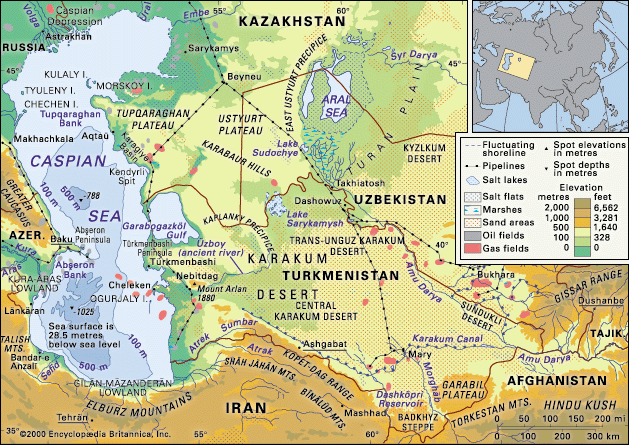
The Ustyurt Plateau is a vast, arid region spanning approximately 77,000 square miles (200,000 square km) across Uzbekistan and Kazakhstan. It is situated between the Aral Sea and the Amu Darya delta to the east, and the Mangyshlak Plateau and the Caspian Sea’s Kara-Bogaz-Gol inlet to the west.1
Characterized by a monotonous desert landscape, the plateau features an average elevation of about 500 feet (150 m), reaching a maximum height of 1,200 feet (365 m) in the southwest. Its edges are marked by steep drops toward the surrounding plains and the Aral Sea. While the terrain offers only sparse pasture for camels and sheep, the area west of the plateau is notable for its oil and natural gas deposits.1
How has the shrinking of the Aral Sea affected the surrounding region?
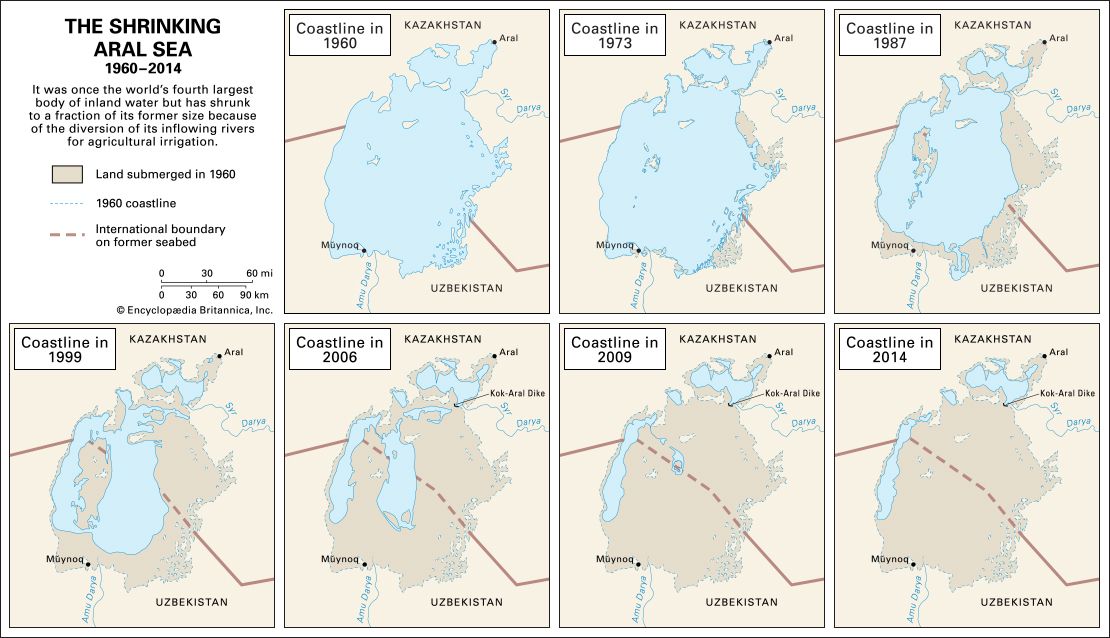
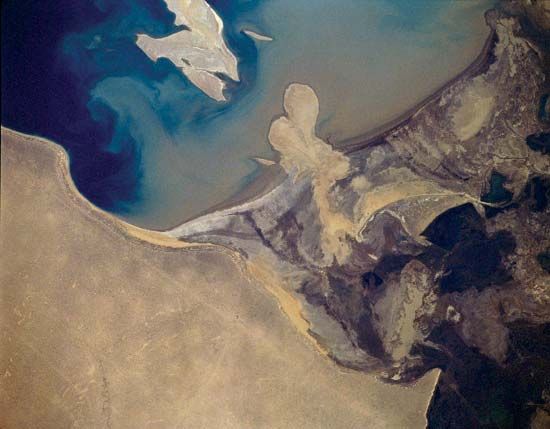
The diversion of the Syr Darya and Amu Darya rivers for irrigation has caused the Aral Sea to shrink drastically, resulting in severe environmental and humanitarian consequences for the surrounding region.23
Environmental and Economic Impact
- Collapse of Industry: The increased salinity and pollution from agricultural chemicals destroyed the once-thriving fishing industry, leaving ports far from the receding shoreline and grounding ships.234
- Climate Alteration: The loss of such a large body of water has made the local climate harsher, leading to more extreme winter and summer temperatures.3
- Toxic Dust Storms: As the seabed dried, winds began carrying salt, pesticides, and fertilizers across the region. This toxic dust has contaminated drinking water and local food sources.23
Public Health Crisis
The human population, particularly the Karakalpaks, has faced significant health challenges. Residents suffer from high rates of anemia, kidney diseases, and throat cancers, while the region has recorded some of the world’s highest infant mortality rates. Additionally, the receding waters created land bridges to former islands, such as Vozrozhdenya, which had served as a Soviet Union biological weapons testing site, necessitating international cleanup efforts.3
What kind of wildlife is adapted to live in this desert environment?
Wildlife in desert environments, such as the Takla Makan or Karakum deserts, is often sparse and concentrated in peripheral areas where water and vegetation are more accessible. Animals in these regions have adapted to survive in harsh, arid conditions with limited resources.
Common Desert Fauna
- Mammals: Small rodents, including jerboas, gerbils, and field mice, are prevalent in dune areas. Larger mammals, such as the goitered gazelle, tolai hare, and hedgehog, are also found on the plains. Predators like wolves and foxes inhabit these regions as well.56
- Reptiles and Insects: Various species of lizards, snakes, and turtles are well-adapted to the desert heat. The insect population is diverse, featuring ants, termites, and various beetles.76
- Birds: Common desert birds include larks, sparrows, and wagtails. Some species, like the Pander’s ground jay, are specifically named for their desert habitat.567
These animals often utilize protective coloration to blend into the arid landscape, helping them avoid predators and survive in environments where vegetation is limited to hardy shrubs, grasses, and occasional trees like the saxaul.576
How do nomadic herders use the plateau for their livestock?
The Ustyurt Plateau, a vast desert region spanning approximately 77,000 square miles between the Aral Sea and the Amu Darya delta, serves as a challenging environment for nomadic pastoralism. Due to the plateau’s arid climate and monotonous landscape, it provides only meager pasture for livestock, primarily camels and sheep.1
In broader pastoral contexts, nomadic herders utilize such plateaus and arid grasslands by following cyclical migration routes, often referred to as “transhumance orbits,” to manage their animals’ needs for forage and water. These communities rely on natural vegetation, moving their herds between seasonal grazing grounds to ensure survival in environments unsuitable for cultivation. Because the Ustyurt Plateau is characterized by its harsh, desert conditions, herders must carefully balance their livestock numbers with the limited available grazing resources to maintain ecological stability.13141
Sources
- Ustyurt Plateau — Encyclopædia Britannica
- Uzbekistan - Drainage — Encyclopædia Britannica
- Aral Sea — Encyclopædia Britannica
- 6 Lakes That Are Drying Up - Aral Sea — Encyclopædia Britannica
- Takla Makan Desert - Plant and animal life — Encyclopædia Britannica
- Steppe — Encyclopædia Britannica
- Europe - Wild animals — Encyclopædia Britannica
- Karakum Desert - Plant and animal life — Encyclopædia Britannica
- Altaisky Nature Reserve — Encyclopædia Britannica
- biogeographic region - Western and Central Asian region — Encyclopædia Britannica
- Kunlun Mountains - Plant and animal life — Encyclopædia Britannica
- Pechoro-Ilych Nature Reserve — Encyclopædia Britannica
- pastoral communities in India — Encyclopædia Britannica
- Primitive culture - Herding societies — Encyclopædia Britannica
Published on · 3 min read