Solimões River
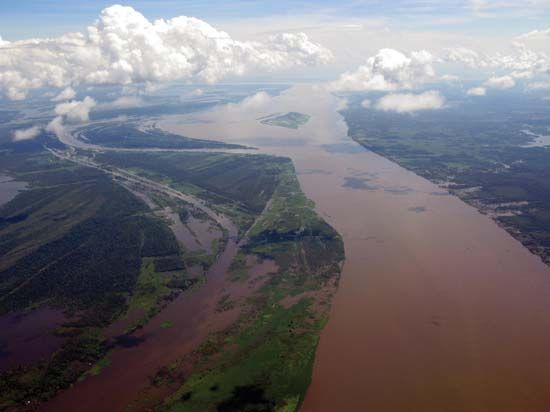
The Solimões River is the name given to the upper section of the Amazon River as it flows through the state of Amazonas in northwestern Brazil.
What is Solimões River?
The Solimões River is the name given to the upper section of the Amazon River as it flows through the state of Amazonas in northwestern Brazil.1
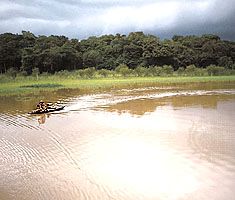
Stretching approximately 1,000 miles (1,600 km), the river winds through a vast floodplain that is about 50 miles (80 km) wide, characterized by a complex network of channels and islands covered in tropical rainforest. The river originates at the Brazilian-Peruvian border and continues until it reaches the Negro River near Manaus.1
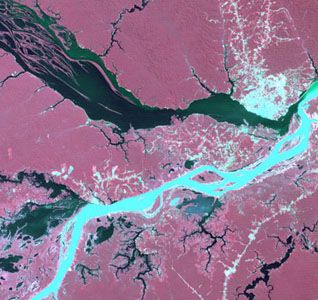
This junction is famously known as the “meeting of waters,” where the muddy, brown-colored waters of the Solimões merge with the dark, black waters of the Negro to officially form the Amazon River.1
Why do the Solimões and Negro rivers not mix immediately?
The Solimões and Negro rivers do not mix immediately at their confluence near Manaus due to significant differences in their physical properties, specifically their temperature, speed, and sediment content.
The Solimões River carries a heavy load of silt, which gives it a muddy, yellowish-brown appearance. In contrast, the Negro River is characterized by its clear, jet-black water, a result of the decomposition of organic matter in swamps and a very low silt content. Because these two bodies of water possess different densities and flow at different velocities and temperatures, they remain distinct for several miles downstream before finally merging to form the Amazon River. This phenomenon is widely known as the “meeting of waters.”12
What kind of wildlife lives in the Amazon floodplain?
The Amazon floodplain, which includes both nutrient-rich várzea and nutrient-poor igapó forests, supports a remarkably diverse array of wildlife that has adapted to seasonal inundation.34
Aquatic and Semiaquatic Life
The rivers and flooded forests are home to approximately 2,500 species of fish, many of which migrate into the flooded forest during the high-water season to feed on fruit and seeds. Notable species include:56
- Tambaqui: A large characin that uses specialized nasal flaps to locate fruit and powerful jaws to crush seeds.6
- Piranha: Known for their sharp teeth, these fish are also important seed dispersers in the flooded forest.56
- Giant Catfish: Various species inhabit the river systems and play a role in the ecosystem’s nutrient cycling.56
- Other Aquatic Animals: The region hosts river dolphins, manatees, alligators, and various turtles. The capybara—the world’s largest rodent—and the nutria are common semiaquatic mammals.5
Terrestrial and Arboreal Wildlife
While large terrestrial mammals are relatively rare, the forest canopy is teeming with life:5
- Primates: Howler monkeys, spider monkeys, squirrel monkeys, and marmosets are characteristic of the region.5
- Birds: The basin is exceptionally rich in birdlife, including parrots, macaws, toucans, herons, and hoatzins.5
- Insects and Invertebrates: Millions of species exist, including leaf-cutter ants, butterflies, scorpions, and spiders.53
- Reptiles and Mammals: Anacondas and boa constrictors are notable, alongside mammals like jaguars, tapirs, and sloths/tapir), and sloths.3
How does the Amazon River compare in size to other major rivers?
The Amazon River is widely considered the world’s principal river in terms of its massive drainage basin and the volume of its water flow.789
When comparing the Amazon to other major rivers, its size is defined by several key metrics:
- Drainage Basin: The Amazon basin covers approximately 2.7 million square miles (7 million square km), making it the largest drainage system in the world. It is nearly twice the size of the Congo River basin.9
- Discharge: The river carries an immense volume of water, estimated to be about one-fifth of all the water that runs off Earth’s surface. Its flood-stage discharge is four times that of the Congo and more than 10 times that of the Mississippi River.9
- Length: While the Amazon is the world’s leader in volume and basin area, it is generally ranked as the second-longest river in the world, measuring at least 4,000 miles (6,400 km). It is typically considered slightly shorter than the Nile River, though its exact length remains a subject of scientific debate.789
Sources
- Solimões River — Encyclopædia Britannica
- Negro River — Encyclopædia Britannica
- Amazon River - Animal life — Encyclopædia Britannica
- Vegetarian piranhas — Encyclopædia Britannica
- Amazon basin — Encyclopædia Britannica
- Amazon River - Plant life — Encyclopædia Britannica
- Amazon River: Top Questions — Encyclopædia Britannica
- river - World’s largest rivers — Encyclopædia Britannica
- world’s longest rivers — Encyclopædia Britannica
- Amazon River — Encyclopædia Britannica
- hydrologic sciences - Runoff and stream discharge — Encyclopædia Britannica
Published on · 3 min read