Vitim Plateau
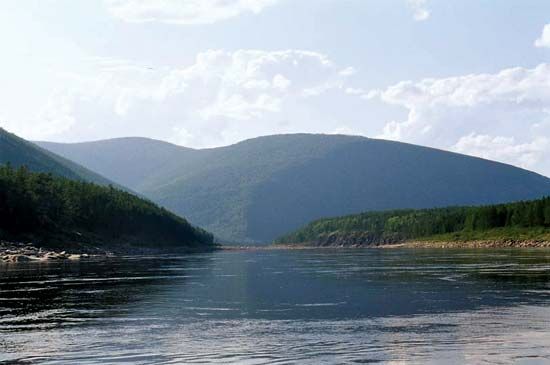
The Vitim Plateau is a gently rolling upland region located in eastern Siberia, spanning parts of the Buryatiya Republic and the Chita oblast (province) in…
What is Vitim Plateau?
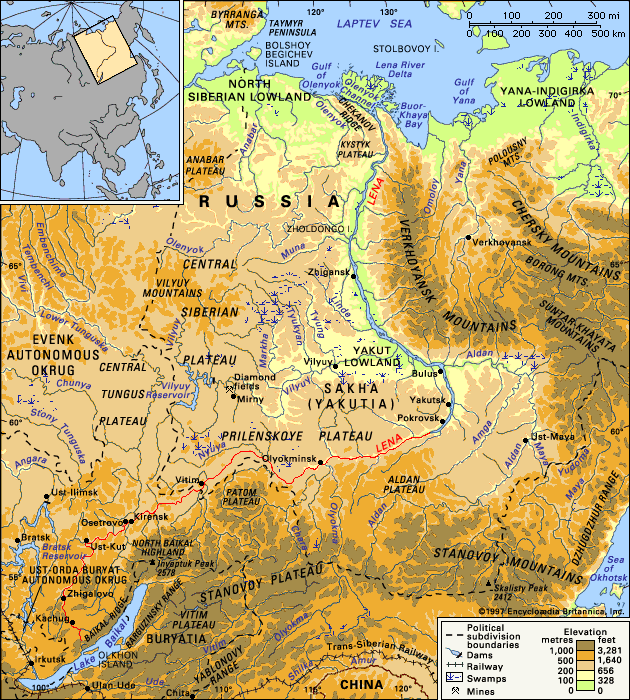
The Vitim Plateau is a gently rolling upland region located in eastern Siberia, spanning parts of the Buryatiya Republic and the Chita oblast (province) in eastern Russia.1
Situated at elevations ranging from 4,000 to 5,250 feet (1,200 to 1,600 meters), the plateau is characterized by a foundation of granites, granite-gneisses, and gneiss-granites. In its central and southwestern sections, the landscape features basalts and basalt lavas, which are the remnants of numerous small, extinct local volcanoes. The region is drained by the Vitim River, which has carved deep, canyon-like courses through the terrain.1
What is the significance of the Vitim River?
The Vitim River is a significant waterway in eastern Siberia, serving as a major tributary to the Lena River. Spanning 1,229 miles (1,978 km), it plays a vital role in regional transportation and industry.2
Its primary significance lies in its navigability, as it is navigable up to the town of Bodaybo. This accessibility is crucial for the region, as Bodaybo serves as the central hub for local goldfields. Additionally, the river is geographically significant for its role in draining the Vitim Plateau, a high-altitude region characterized by its unique volcanic geology and deep, canyon-like river valleys.23
How do extinct volcanoes shape the landscape?
Extinct volcanoes play a significant role in shaping the Earth’s surface as residual landforms, which are remnants of ancient landscapes that have escaped destruction to persist in the modern environment. Their influence on topography is diverse, depending on their original structure and the processes that follow their dormancy.4
Common Volcanic Landforms
- Volcanic Cones: These are often left behind as distinct, recognizable peaks that stand out in the surrounding terrain.4
- Calderas: Many extinct volcanoes are marked by large, circular or oval depressions formed by the inward collapse of the land after massive eruptions. These features are often surrounded by steep cliffs and may contain lakes within their basins.5
- Lava Plateaus: Large-scale volcanic activity, particularly from fissure vents, can create expansive, elevated plains of hardened lava that define the regional landscape.6
- Hydrothermal Features: In areas where igneous rock remains hot at shallow depths, extinct volcanic regions may continue to shape the environment through the creation of hot springs, fumaroles, and solfatara fields as they interact with groundwater.7
What kind of wildlife lives in eastern Siberia?
Eastern Siberia features a diverse range of wildlife that varies significantly across its natural zones, primarily the taiga (coniferous forest) and the tundra.11
Taiga Fauna
The taiga supports a rich variety of mammals and birds. Common inhabitants include:
- Predators: Brown bears, wolves, lynx, wolverines, ermines, and sables.1213
- Herbivores: Elk, reindeer, and various species of squirrels and hares.1213
- Birds: Species such as grouse, woodpeckers, nutcrackers, and Siberian jays.1213
Tundra Fauna
In the northern reaches, the environment is harsher, leading to specialized adaptations:
- Mammals: Lemmings are a keystone species, with populations that fluctuate in cycles, influencing predators like Arctic foxes and snowy owls. Large herbivores include reindeer and musk oxen.1214
- Insects: Despite the cold, insects like mosquitoes and black flies are present, often utilizing glycerol as a natural antifreeze.1
Aquatic Life
The region’s rivers and lakes, such as Lake Baikal, host unique species. Commercially important fish include sturgeon, salmon, and perch, while Lake Baikal is famous for its endemic species and the Baikal seal.1113
Sources
- Vitim Plateau — Encyclopædia Britannica
- Vitim River — Encyclopædia Britannica
- Vilyuy River — Encyclopædia Britannica
- volcano - Determinants of size and shape — Encyclopædia Britannica
- volcano - Shield volcanoes — Encyclopædia Britannica
- continental landform - Consideration of unique landforms and other distinctive topographic features — Encyclopædia Britannica
- North America - Cenozoic volcanic fields — Encyclopædia Britannica
- residual landform — Encyclopædia Britannica
- volcano - Calderas — Encyclopædia Britannica
- volcano - Other volcanic structures and features — Encyclopædia Britannica
- Ural Mountains - Animal life — Encyclopædia Britannica
- Taiga - Other plants — Encyclopædia Britannica
- Lena River — Encyclopædia Britannica
- Tundra - Arctic mammals — Encyclopædia Britannica
- Altai Mountains - Animal life — Encyclopædia Britannica
- Asia - The taiga — Encyclopædia Britannica
- Tundra - Insects — Encyclopædia Britannica
Published on · 3 min read