Wren-babbler
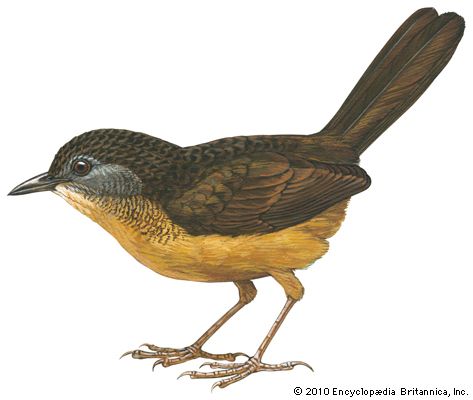
A wren-babbler is any of approximately 20 species of small Asian birds belonging to the babbler family, Timaliidae.
What is Wren-babbler?
A wren-babbler is any of approximately 20 species of small Asian birds belonging to the babbler family, Timaliidae.1
These birds typically measure between 10 and 15 centimetres (4 to 6 inches) in length. They are characterized by their short tails and relatively short, straight bills, which distinguish them from the closely related scimitar-babblers. Wren-babblers are primarily found in southern Asia and the East Indies, often inhabiting thickets in small, restless flocks. An example of this group is the streaked long-tailed wren-babbler, which is native to northern Indochina.12
What defines the Timaliidae bird family?
The Timaliidae family, commonly known as babblers, is a diverse group of passerine birds found primarily in Asia and the Philippines, with some representatives in Madagascar.34
Physical Characteristics
Members of this family are generally characterized by the following features:
- Wings and Bill: They typically possess short, rounded wings with a large outer primary and a bill that resembles that of a thrush.4
- Size and Appearance: They vary in size, such as the tit-babblers, which are chunky birds measuring 10 to 18 cm (4 to 7 inches) in length.3
- Plumage: Many species exhibit fluffy plumage, sometimes featuring hairlike feathers on the back. Their coloration is generally muted, consisting of black, gray, reddish, or brown tones, often with white or yellow underparts.3
- Development: A notable trait of the family is that their young are unspotted.4
While the family includes a wide variety of forms that may not all be closely related, they are often categorized into distinct subfamilies, such as the tit-babblers.34
How do wren-babblers differ from scimitar-babblers?
Wren-babblers and scimitar-babblers are both members of the Timaliidae family, but they are distinguished by significant differences in size, bill shape, and tail length:
- Bill Shape: The most notable difference is the bill. Wren-babblers possess a relatively short, straight bill, whereas scimitar-babblers are defined by their long, curved bills, which they use to uncover insects in ground litter.16
- Size: Wren-babblers are smaller, measuring between 10 and 15 cm (4 to 6 inches) in length. In contrast, scimitar-babblers are larger, typically ranging from 18 to 28 cm (7 to 11 inches).16
- Tail Length: Wren-babblers are characterized by their rather short tails, while scimitar-babblers possess fairly long tails.16
What are some other bird species found in southern Asia?
Southern Asia, particularly the Indian subcontinent and the broader Oriental region, hosts an immense diversity of avian life due to its varied habitats, ranging from alpine tundra to tropical jungles.78
Notable Bird Species
- Game Birds: This group includes peacocks, pheasants, jungle fowl, partridges, and quails.78
- Birds of Prey: The region is home to numerous eagles, hawks, vultures, falcons, kites, and buzzards.78
- Water and Wetland Birds: Common species include herons, storks, ibises, flamingos, cranes, gulls, terns, and kingfishers.78
- Forest and Tropical Birds: The region features a wide variety of hornbills, barbets, woodpeckers, cuckoos, pigeons, and parakeets.78
- Passerines: Familiar birds include crows, mynahs, larks, thrushes, flycatchers, and bulbuls.78
Additionally, the great Indian bustard is a notable, though endangered, inhabitant of the region’s grasslands.8
Sources
- Wren-babbler — Encyclopædia Britannica
- wren babbler — Merriam-Webster
- Tit-babbler — Encyclopædia Britannica
- Timaliidae — Merriam-Webster
- Timalia — Merriam-Webster
- Scimitar-babbler — Encyclopædia Britannica
- Asia - Birds — Encyclopædia Britannica
- India - Birds — Encyclopædia Britannica
Published on · 2 min read